MARRAKECH
In narrow lanes pedestrians compete with motor bikes, scooters and bicycles going in both directions weaving between unconcerned pedestrians. Last night an out of control donkey cart came careening towards us around a blind corner. We narrowly escaped into a tiny shop front in absolute terror while the driver shouted abuse at the donkey in Arabic, bashing it repeatedly on the head with a thick piece of timber.
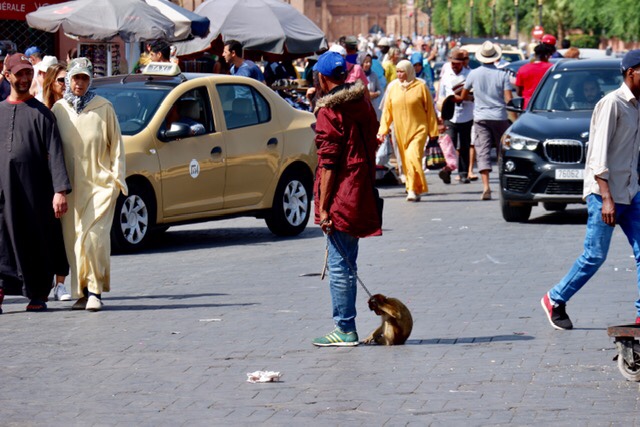
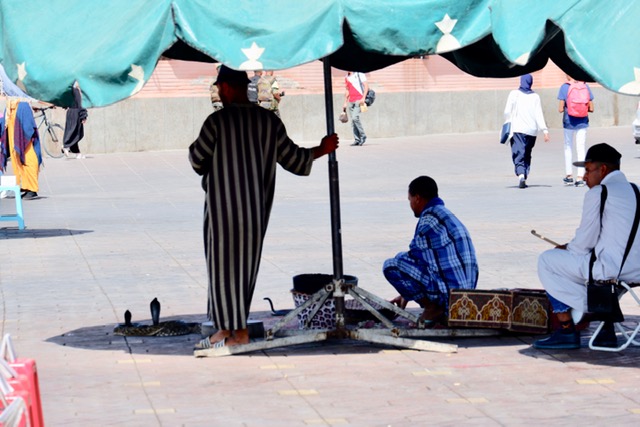
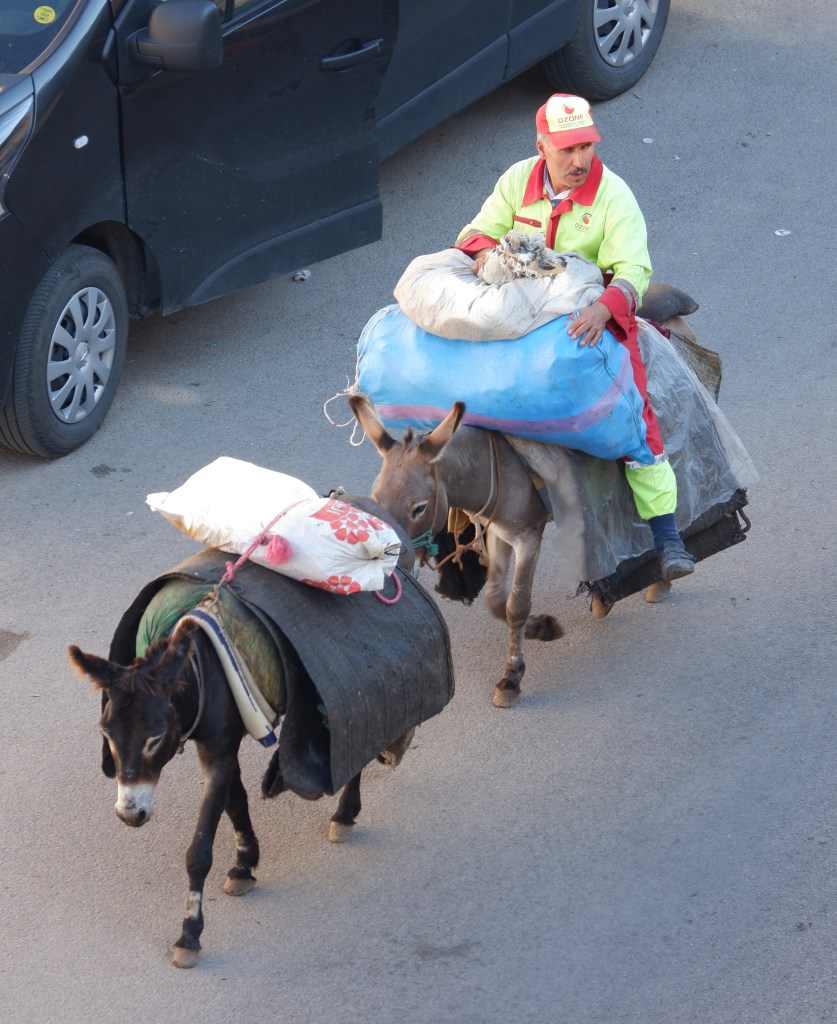
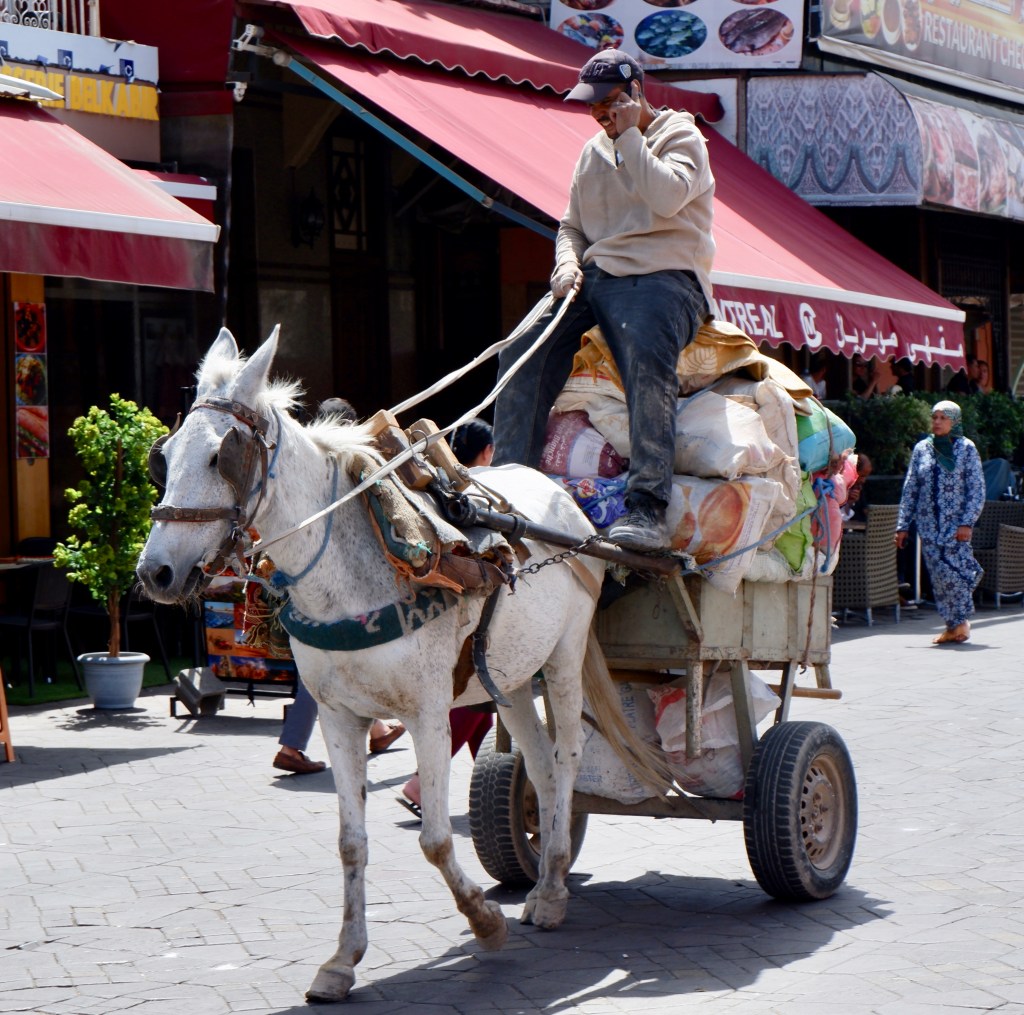
Wow! This was such a change from France! It’s a mix of India, the Middle East and Africa. Monkeys on leashes (poor little buggers) posing for photographs with tourists, snake charmers, musicians, ladies offering to henna hands, fortune tellers and food vendors all compete for space in the square. Refugees from Libya and Liberia trying to earn some money before attempting to reach Europe, pester tourists to buy sunglasses and African shirts. Poor scrawny donkeys overburdened with produce or building rubble and malnourished horses hooked up to coaches for tourists to ride around in, would make some of my animal-loving friends despair.
This morning we saw a man on a motorbike with a baby no more than a few months old strapped to the front of his body, casually weaving his way through all the chaos one-handed while casually stroking the baby’s head. To say that the whole experience here makes me feel alive is an understatement. Every few minutes one of us says to the other ‘did you see that?’, or ‘discretely look to your left’. The photographs can capture only a fraction of what we have been experiencing. Words fail me. It is terrifying, exhilarating, exciting and sometimes very sad.
This is not the right place in the world to be living if you are frail, sick, handicapped, mentally ill or old. Seeing an old man being pulled through the alleyways in a wooden trolly and watching a frail old lady trying to navigate her own way using an antiquated pram as a walking frame made me feel so grateful for the care that my own parents have received and the dignity that has been afforded to them. Young people with mangled and deformed bodies, the blind, amputees and anyone without family support, have little option but to beg on the streets. The deranged wander aimlessly in the alleyways and are ignored. No Centrelink payments or Work for the Dole here. It is only by chance of birth that we, and everyone else who reads this, do not have to struggle for mere survival.
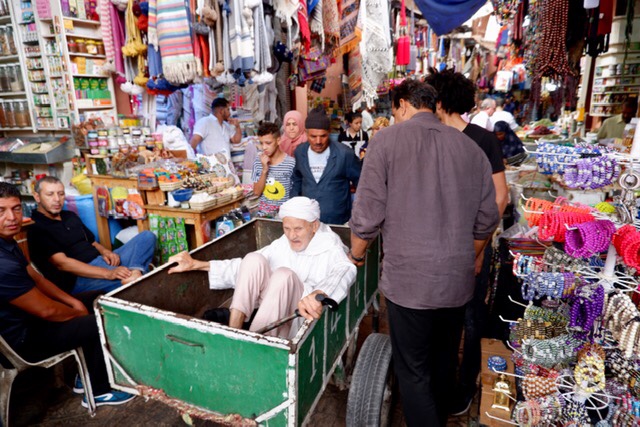
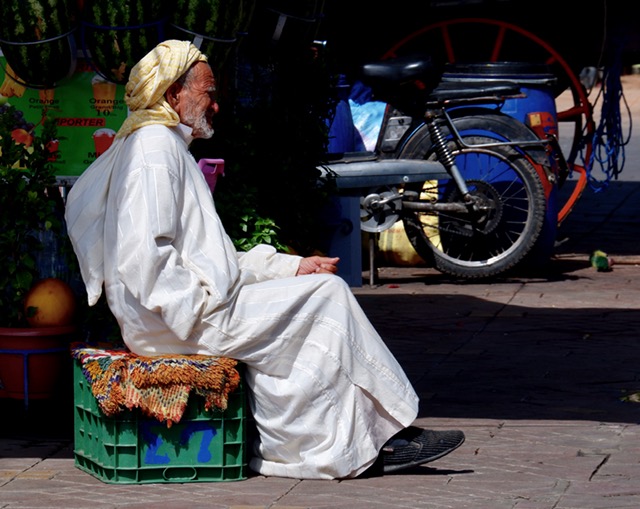
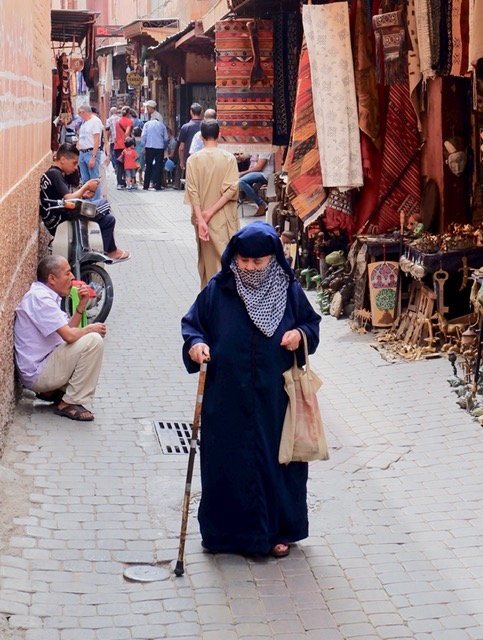
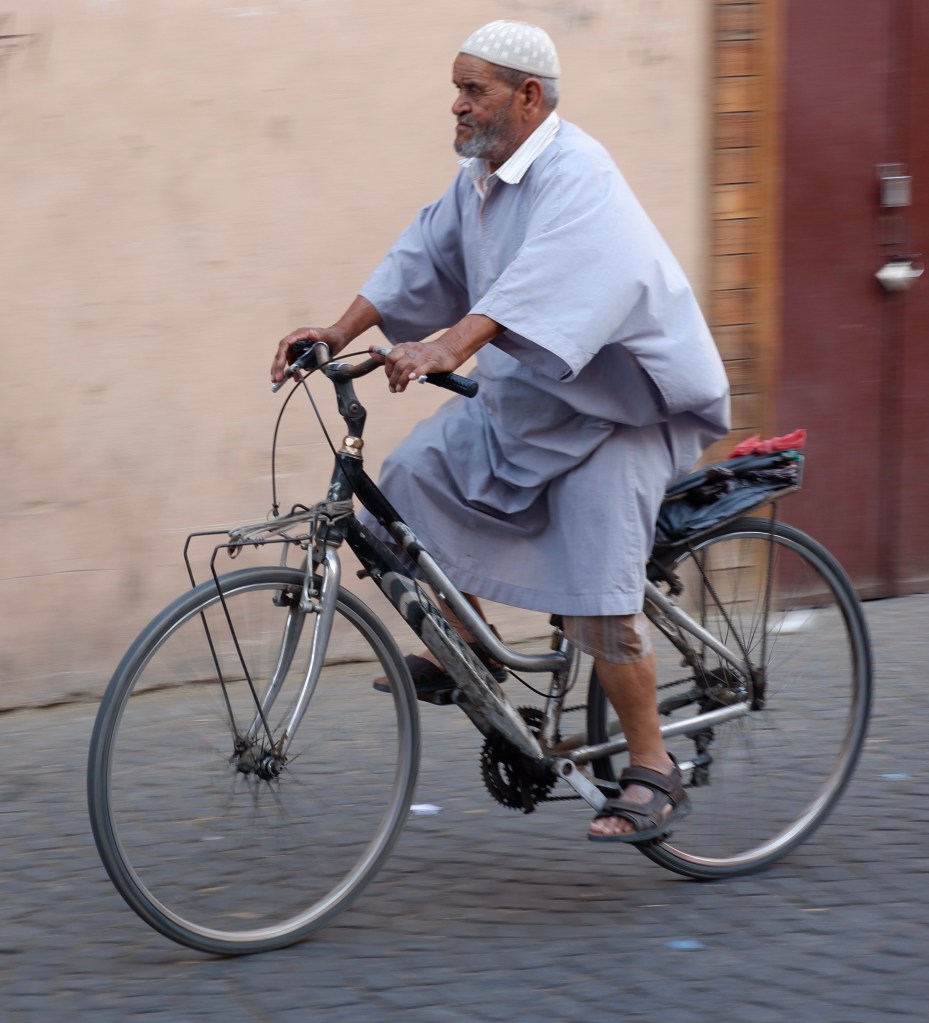
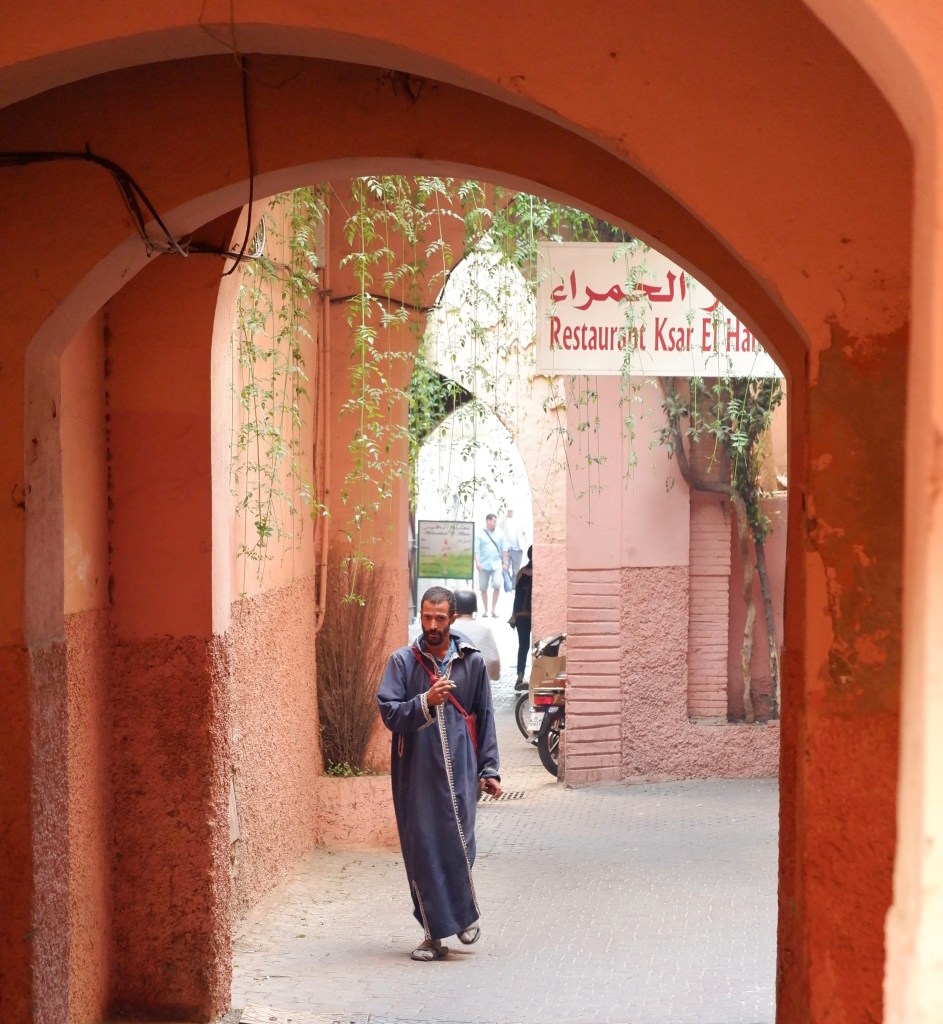
We were told that Marrakech has about 20,000 motorcycles. That has to be an under estimate! Everyone, kids, teenagers, wizened old guys, women in full chador and sometimes WHOLE families, flash past you atop mopeds, scooters and step-throughs of all kinds! To say the traffic here is chaotic goes nowhere close to describing it. The worst part for us is walking through crowded alleys with the aforementioned motorised traffic, going in both directions, weaving between unconcerned local pedestrians. We were the exception – we were very concerned pedestrians (sometimes terrified!).
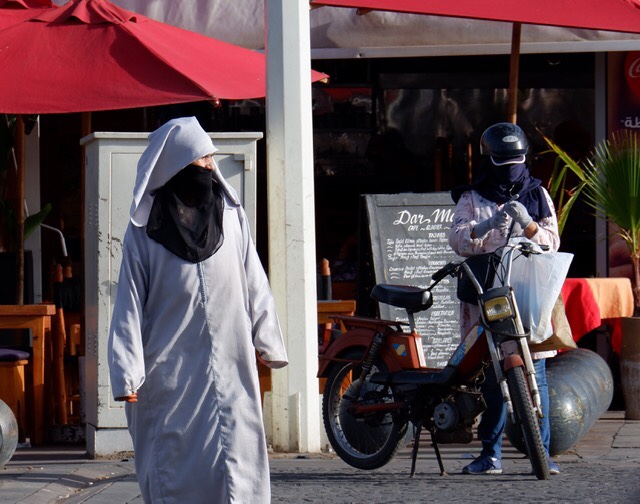
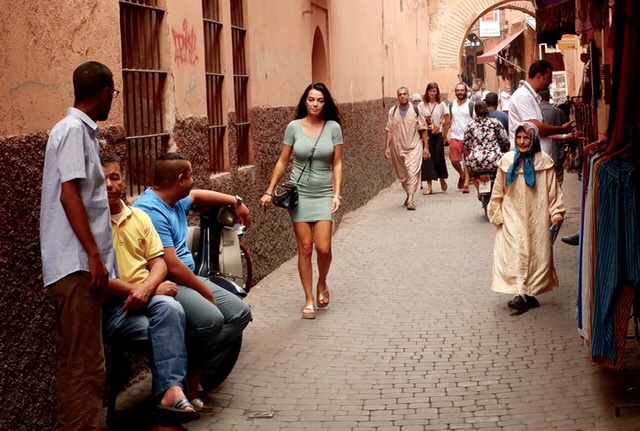
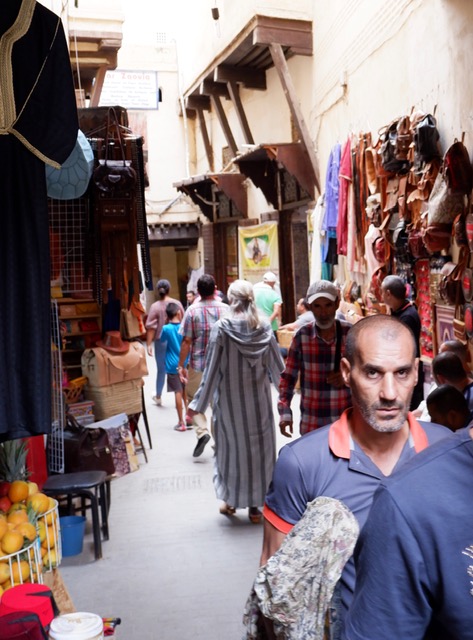
Notice the different modes of dress
FES
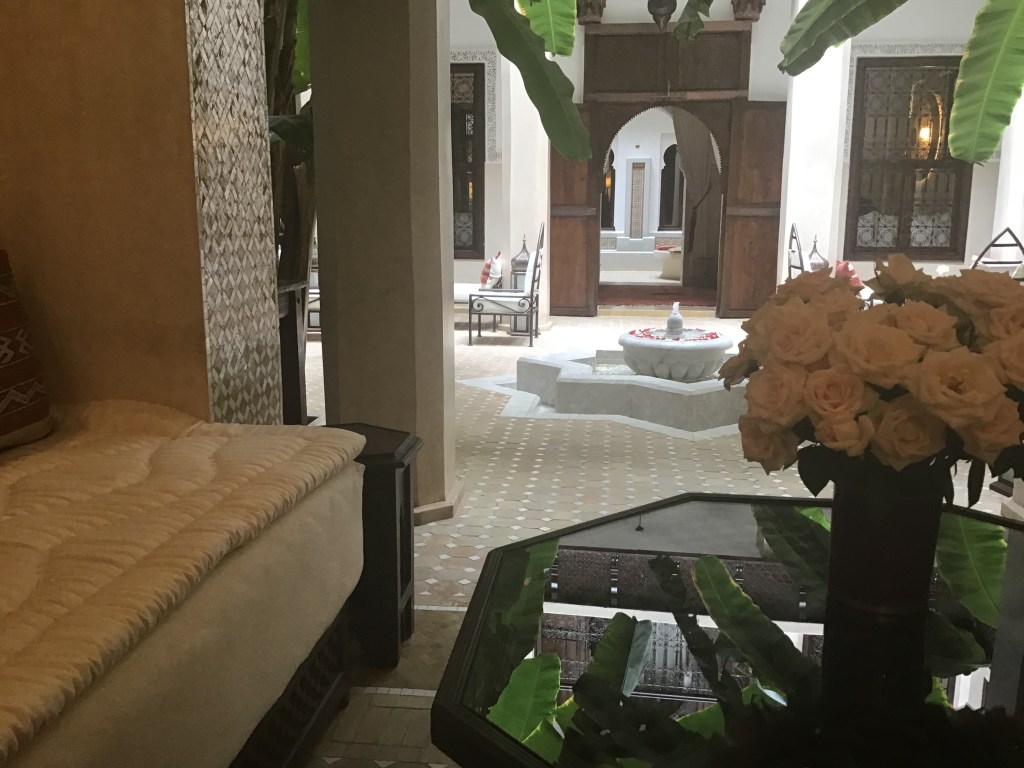
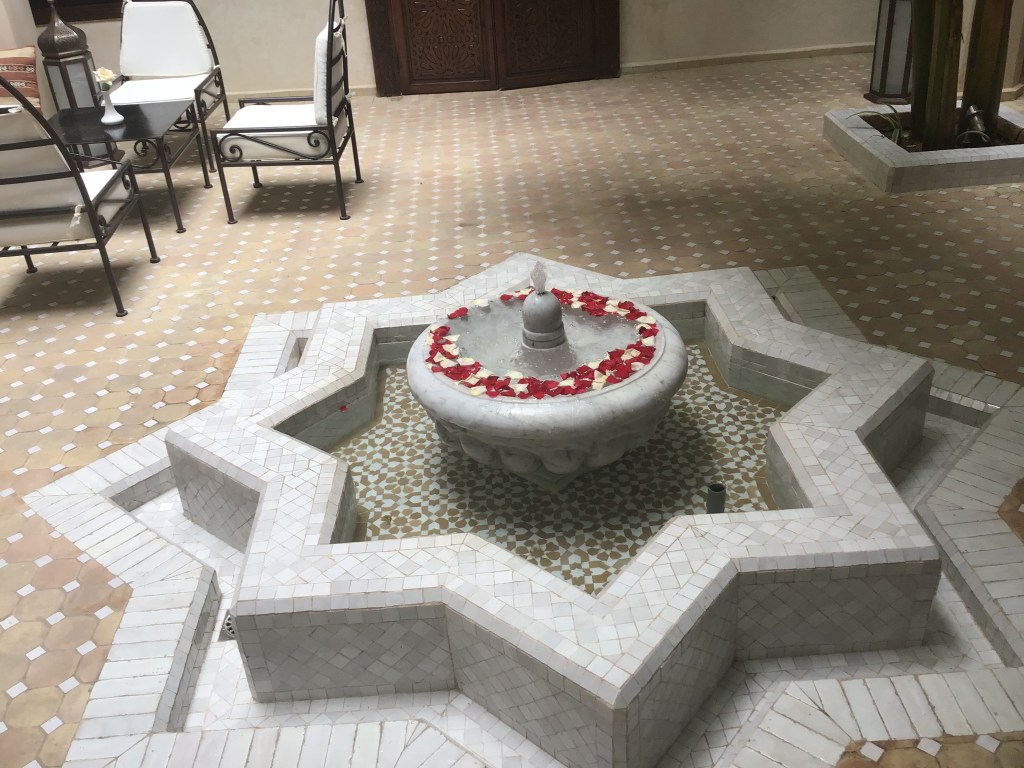
After the bustle of Marrakech, Fes (previously I had always presumed it was spelled ‘Fez’) felt instantly soothing. Although clearly much larger and with a higher population than Marrakech, it seems to be more spread out. Once again, we are in the Medina, behind the walls in the old town. Our Riad Fes Maya is absolutely glorious with the typical open courtyard giving the only access to the outside world (the high up stained glass windows are never opened to the outside world) and rising up over three floor to the rooftop. Once a palace, the ornate mosaics and hand chiselled cedar wood is complimented by brass fittings, stained glass and hand woven rugs. There are only nine rooms in total, so it feels very intimate. The tables and chairs in our room are made of inlaid mother-of-pearl and the heavy doors and shutters on the windows are of carved cedar. Even the black marble sink in our bathroom sink is embedded with ammonites and other fossils. Barry keeps marvelling at the extraordinary craftsmanship of the hinged doors and windows, the hand-crafted wrought screens and bolster rails. It is all over-the-top but it is absolute paradise!
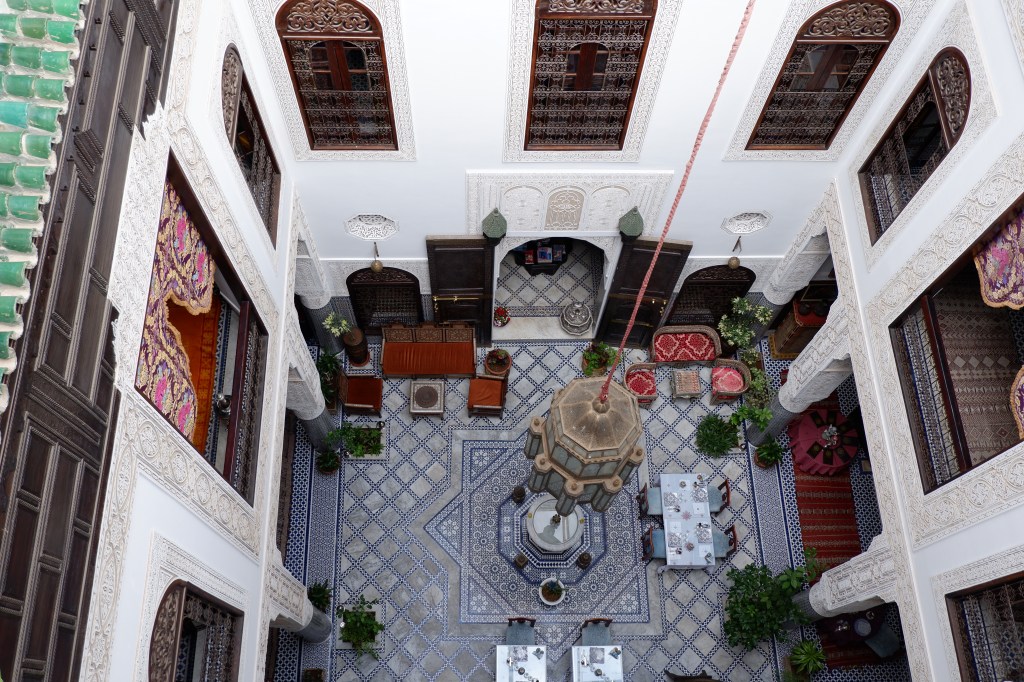
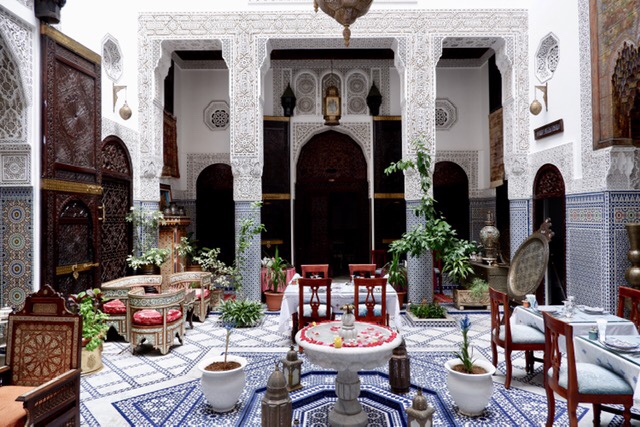
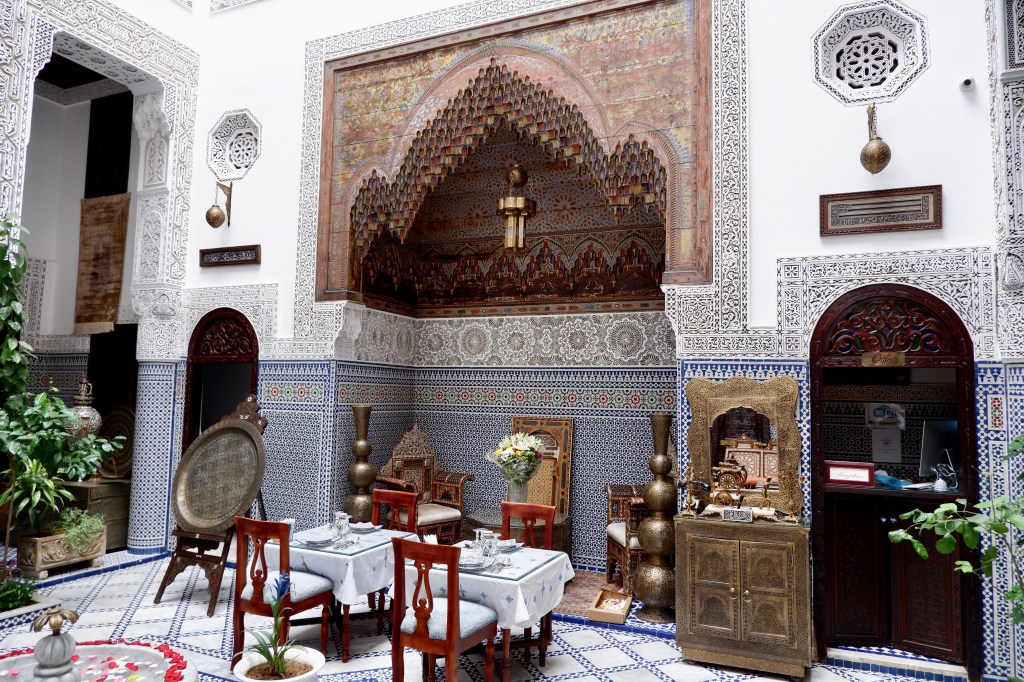
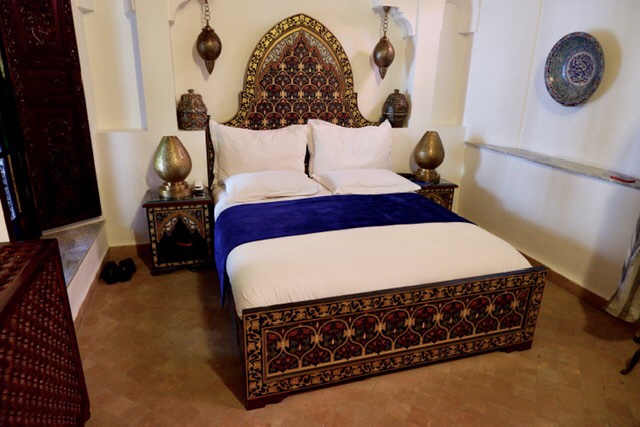
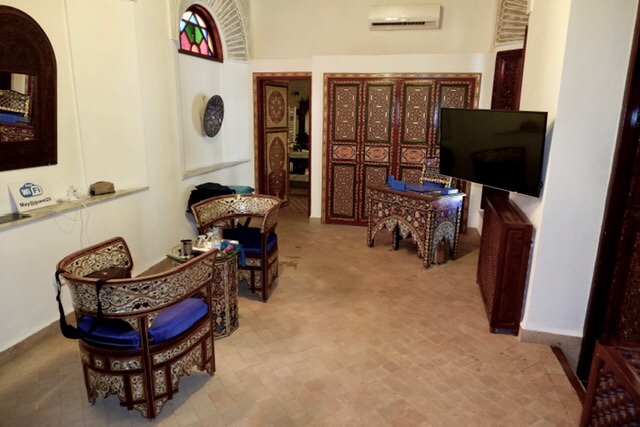
We were given a ‘complimentary’ half day city tour by a self-professed university art teacher, whose only interest in conducting tours on a voluntary basis was for fostering International Relationships. I immediately smelled a rat and made it clear that we were not interested in buying ANYTHING. First he took us to a tailor and we watched him making a lovely dress completely by hand including some intricate embroidery. He then took us to a woodcarver who was making the ornate cedar roof panels similar to the ones that adorn our rooftop restaurant. My sense of foreboding really increased when he took us to see some weavers who were just sitting around when we walked in and then immediately jumped and started operating the pedals of the loom and clacked the shuttles across twice before having us sit down and one by one, unfurling shawls, scarves and fine blankets over my knees. Adamant that I was not interested in buying, we managed to escape quite easily. Next came the carpet shop: a place set up for widows to prevent them from having to resort to prostitution and make a decent living from weaving carpets and of course, no children were ever used for labour. Here my insistence that I didn’t want to buy anything seemed to fall on deaf ears and the pressure became infuriating to me. Carpets were unfurled, explanations of the techniques, colours, knots continued. Which ones did I like best? Perhaps just a small one? The guide finally realised that I didn’t appreciate the badgering and took us off to see the tannery: now this was something really worth seeing!
The Chaouwara tanneries are one of Fes’s most iconic sights (and smells). It was a unique opportunity to witness the pungent, natural processes of producing leather that haven’t changed since medieval times. Without a guide, the only other method of access is from one of the surrounding leather shops who will pressure for a sale in return for using their viewing platform. The mint that is handed out at the door is meant for holding up to the nose to detract from the stench. Unaware of this purpose, I immediately started munching mine, causing barely disguised amusement from the sellers.
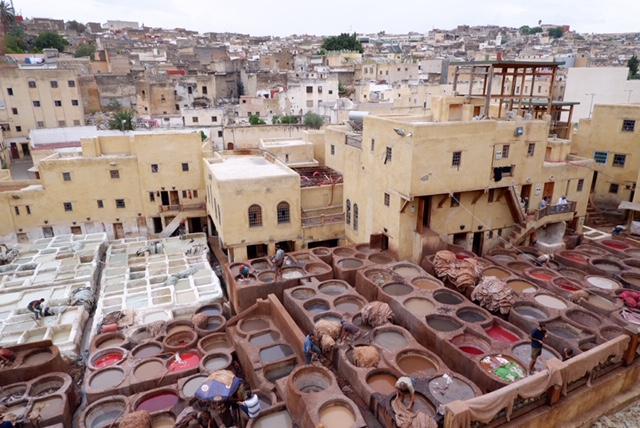
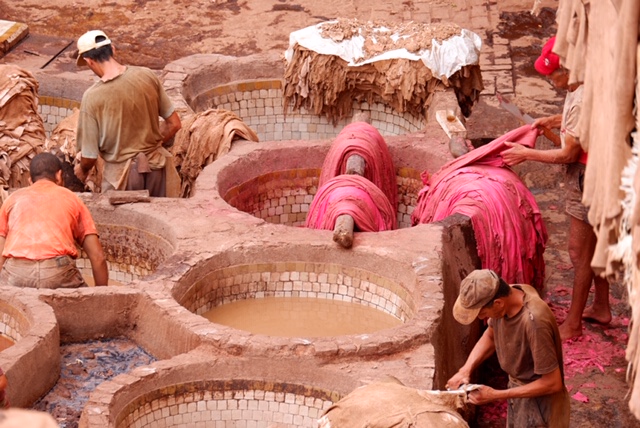
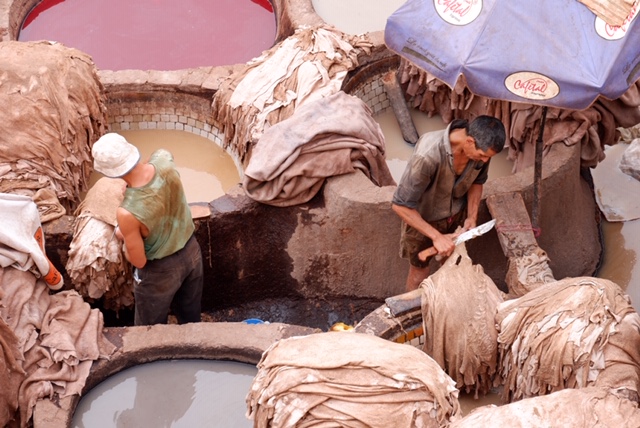
Men trample waist deep on skins that are submerged first in stone vats filled with a combination of water, pigeon poo, lime and salt to soften the hides of cows, sheep, goats and camels. The hides are soaked for two to three weeks in this mixture, after which tanners scrape away any residual hair, fat and flesh. Then it is time to put them into the deep vats of dyes mixed with cow urine that helps with absorption of dyes used and coming only from natural products: poppies for red, saffron for yellow, indigo for blue, jacaranda flowers for purple, mint for green. Once again men trample the hides, this time for up to two weeks to get the desired colour.
It really was a fascinating experience but once again our guide and the leather salesman were both disappointed by my unwillingness to buy anything. By now the guide was really fed up with us and completely aware that I meant it when I said that I had no desire to buy anything. Plainly, despite him professing to be a ‘volunteer’, any purchase we made would afford him a commission. He wanted to know if we wanted him to take us for lunch and when we declined with the truthful response that we don’t eat lunch, he really cracked it and said that he would take us back to the Riad. We almost had to break into a run to catch up with him as he strode away, heading for the Riad.
On route we heard a voice calling out ‘hello Australian man’. Accustomed to touts already we had developed the habit of either ignoring them or politely tapping our heart with our right hand, giving a slight bow of the head and saying ‘la, shukran’. So it took a moment to realise that someone knew that Barry was Australian. He wasn’t wearing an Akubra or Blundstone boots, so it must have been someone we had met. Sure enough it was the Argentinian couple that had been on the same flight from Marrakech with us and with whom we’d had a brief discussion at breakfast. The guide took one look at them with bulging bags from their souk purchases and immediately befriended them and started babbling away in fluent Spanish, ignoring us to such an extent and that he didn’t even acknowledge our farewells when we arrived back at the Riad.
CHEFCHAOUEN
We had organised for an English speaking driver to take us to Chefchaouen, the so-called ‘blue city’ located in the Rif mountains close to Tangier. It is known as the blue city because of the influx of Jews fleeing first from Spain in the 1400s and then from Hitler in the 1930s who settled there and painted their houses blue as a symbol of the sky and the heaven and a reminder to live a spiritual life.
The trip was a gruelling four hours. We drove higher and higher into the mountains. When Chefchouen was only about 15 minutes away, according to Ibrahim, we came to the outskirts of a small village on its market day. Ibrahim explained that in this remote area, people came from as far as 7 kilometres away (!) on foot or on donkeys to sell their produce and buy their necessary supplies. However, that didn’t prepare us for the traffic snarl that ensued! We crawled through the village at a snail pace, stopping frequently. Out the other side, we climbed into the mountains. At a clear vantage point, Ibrahim pulled over to allow us our first glimpse of Chefchouen, clinging to the mountain side. Interestingly, while we expected a panorama of blue, the town was essentially whitewashed, dotted here and there with blue houses. Once inside the Medina of Chefchouen, it was a very different story. We walked down a series of winding, narrow lanes. Within those streets, one house after another was painted in a variety of shades of blue. Admittedly, once again, we became slightly disoriented (lost) making our way back to the main square.
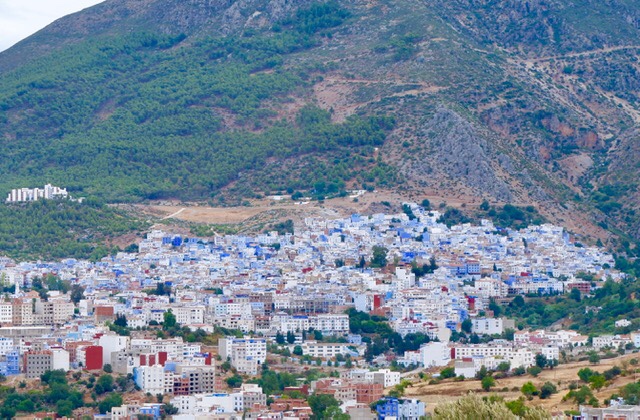
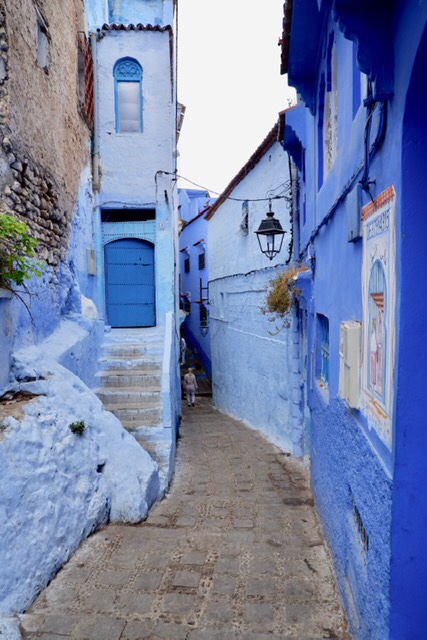
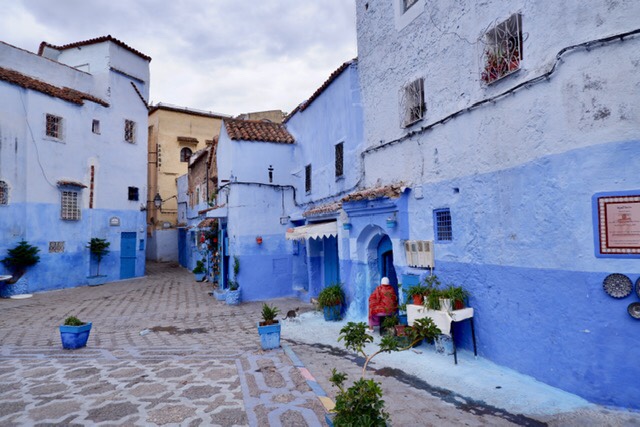
We had a couple of interesting surprises. One was the open selling of hashish and marijuana in the souk, another was the sight of obviously ‘stoned’ people in and around the area. Known here as ‘Kif’, marijuana is thought to have been introduced by Arab invaders in the 7th Century. Sultan Hassan gave five villages in the Rif mountains special permission to cultivate marijuana while restricting its cultivation elsewhere. While technically illegal, Morocco is the world largest exporter of cannabis resin and half the world’s hashish comes from this area. It is said that over 800,000 Moroccans work in the industry. So it is unsurprising that many of the tourists that flock to the area do so not for the photographic opportunities, but to ‘score’.
Although special permission has been given to the area to cultivate, sell and smoke the drug, prospective buyers should be very cautious about taking the drug out of town. At the entry and exit of every town and city, we have noticed the presence of heavily armed soldiers and police. They scan the occupants of every vehicle and occasionally pull some over for extra scrutiny. Leaving Chefchaouen, however, was our first experience of seeing multiples of cars, busses and trucks pulled over and very carefully searched. The penalty for the possession of marijuana in Morocco is up to ten years imprisonment and tourist are often made an example of.
VOLUBILUS, MEKNES AND MOULAY IDRISS
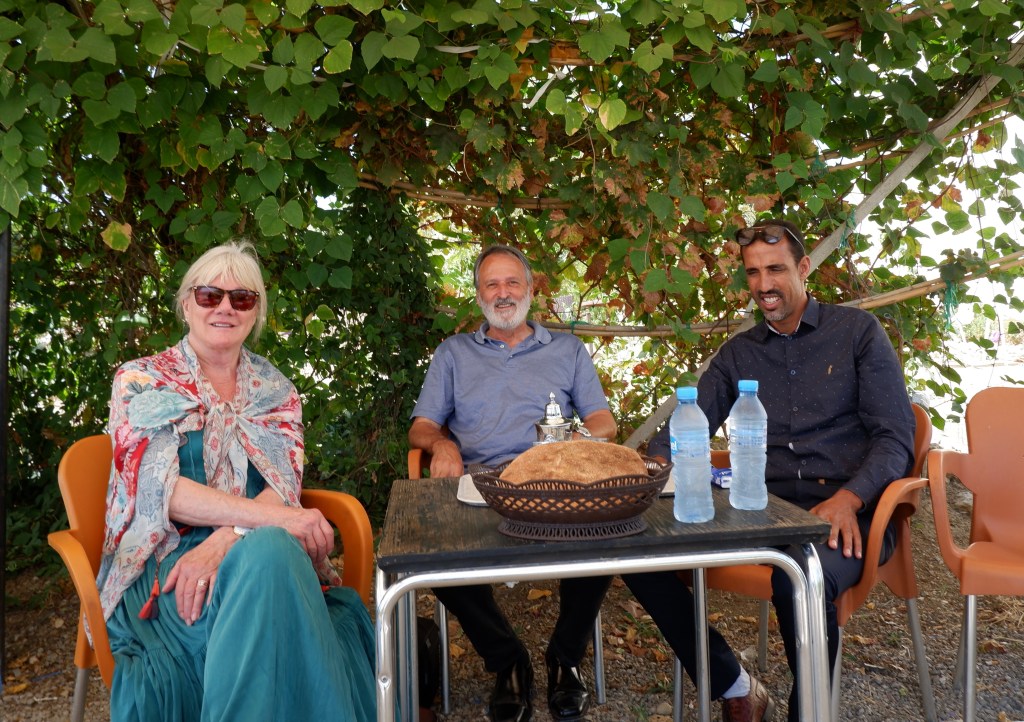
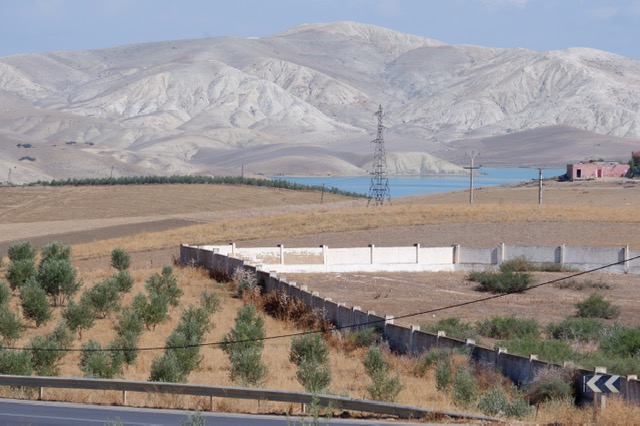
After our one day of rest, the next tour we had booked with Ibrahim was to Meknes Volubilus and Moulay Idris. Fortunately our departure time was 10 am. So we were able to have a more relaxed breakfast. Ibrahim was waiting when we came down. The distance was much shorter that to Chefchouen, but in the same general direction. We settled in for the drive. At about halfway. We stopped for a break at a small family road house. We sat outside in a shady covered area and were served mint tea and a freshly baked loaf of coarse bread. The mountains in the distance, above a azure blue lake, were strikingly white, as if covers with snow. We took some photos and resumed our journey to Volubilus.
The site at Volubilus covers the area of a small city, which is it was throughout its long history until the 4th Century when it was apparently abandoned. A Roman city at its inception, it had all of the iconic buildings common in the Empire. There were bath houses with pools and hypercaust under-floor heating, impressive villas, temples and an open forum. The remains of houses and streets covered much of the site. However, over the centuries of it being inhabited, Volubilus had successive civilisations after the Romans. The last being the Muslim rulers who came in from Spain. As such, much of the city was overlaid with construction and modifications that diminish its reflection of a true Roman settlement. Added to that, it was obvious that the site had undergone a significant restoration. Unfortunately, that reconstruction was rudimentary at best, with columns rebuilt with bricks filling in missing or broken segments. Above the columns, arches and other masonry blocks seem to have been unevenly and randomly placed to ‘finish’ a missing span. However, despite the unsympathetic patchwork restoration, the site is nonetheless significant and its modern museum is small but world class.
Moulay Idris was a city perched high on the side of a mountain, not unlike Chefchouen, except that it was not distinguished by historically motivated blue painted houses. A stop had been planned, but we chose to simply take it in with our eyes as we drove on without stopping. By that time, Moroccan villages were appearing very similar from one to the next. It had been the city founded by one of the first Muslim rulers of Morocco, Moulay Idris. We drove on through without stopping and went on to Meknes.
We stopped outside the Medina at Meknes and Ibrahim said he would have lunch while we walked through the Souk. He parked the car and gave us directions to the Souks about 600 metres away. We walked through the city gate inside the walls. There were three tour busses parked just inside. Not a good sign to us. The Souk was more open than in either Marrakech or Fes but it lacked their distinct cultural interest. We hadn’t wanted to stay there for long and said we’d meet Ibrahim at 3.15 pm, only a half hour of exploration. When we got back into the car, Ibrahim was a bit emotional. He said he’d been “raining” (crying) as he read a review about him as a driver and tour operator on TripAdvisor. It didn’t occur to him that it was OUR review of him following our tour with him two days before! Thankfully, that concluded our tour and we returned to Fes on the motorway.
The return drive to Fes took about two hours. It had been a long day for us. On the way, we had asked Ibrahim if he would stop at Carrefour for us. We knew it was out of his way, but he was obliging enough to do it for us. We jumped out of the car saying we would only be 10 minutes. We were back in the car right on time! We knew exactly what we needed and where to find it. Wine, naturally, and some sliced (non-Muslim) ham, salami and a baguette! That was dinner sorted!
Back at the Riad, we had our appointment at the Hammam booked for 5 pm. There was just time to relax for a while with a lemonade in the downstairs Marjolis (lounge). We asked how we should be attired for the Hammam ritual. That was just to be in our robe and slippers, wearing only underpants. The Hammam room was warm, not hot, with a tiled floor and walls with low marble benches for us to lie on, at right angles to each other. We expected that I would have a woman and Barry would be attended by a man. But we were met at the door by a stocky attractive woman. We were each told to sit down on the benches. Then, unexpectedly, a bucket of hot water was tipped over each of us in turn. We were each soaped, scrubbed and sluiced repeatedly with warm water. Then came the (painful) salt scrub with a coarse scouring mit as an effective exfoliant. It’s a wonder we had any skin left! We were then smeared all over with a black clay rub. Then we relaxed, flat on the warm hard marble … until the next bucket of warm flushing water flooded over us!
It was a hypnotically relaxing experience. That was followed by a 30 minute massage with fragrant oils. It was pure indulgent pleasure, utterly satisfying and so completely relaxing. We left soothed, peaceful and calm, yet at the same time a feeling of diffuse, peaceful elation. It is something we will definitely to do again. The next day we took as a ‘lay day’, rising late, breakfasting, then wandering around the Medina taking in the visual and cultural wonders.
On our last full ‘free’ day we decided to walk to the Jewish area. The map we’d been given at the Riad was abyssmal. It was so small that it was almost impossible to read street names. That probably didn’t matter, as so few streets have names on them! Using google maps was much clearer and gave interactive directions. However, the streets are so impossibly labyrinthine and devoid of street name signs, that we invariably got lost on all but the major roads. We walked in the hot sun for nearly six hours. Steps here are three times the height of our steps. We walked up and down a lot of steps! It was really tough and I’m actually starting to recognise the ageing process. We finally made our way to the Jewish quarter. Every Moroccan city has one and it is always stressed that there has never been fighting or discrimination in Morocco based on religion. We went to the Jewish cemetery. Barry looks cute in a Yarmulka. Then we went to a four hundred year old synagogue. It is rarely used today, and even then, only by very old people. The young Muslim woman who showed us around pointed out the Torah, the Bema and most interestingly, the women’s place of segregated worship upstairs. She didn’t accompany us, but pointed the way down very steep stairs to the natural well (mikveh) where women cleansed themselves ritually themselves after menstruation and childbirth and before marriage. which caused them to be in a state of ‘Niddah’. Immersion in the mikveh is believed to create ritual purity. We were told that there is now a new synagogue in ‘new city’ outside of the Medina and that is where the Jews now worship. We were very surprised to discover that there are now only forty or fifty Jews left in Fes because the rest have migrated to Israel.
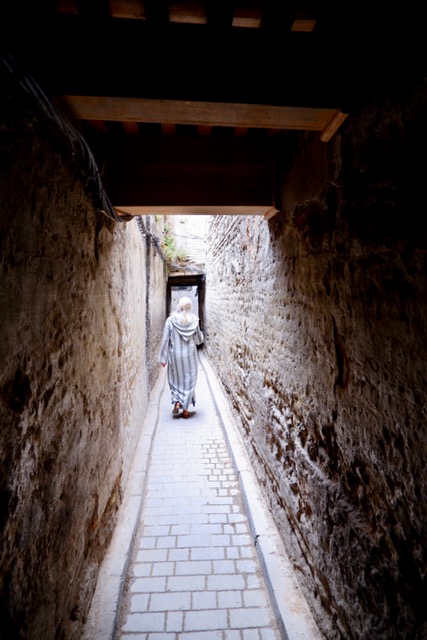
Tired of the lacklustre and inconsistent meals that had been provided at the Riad, we decided to chance one of the small restaurants at the Souk for some barbecued meat. We consulted TripAdvisor for recommendations and settled on ‘Mister Akami’ as one that was highly praised. Google maps suggested that it was just a short 10 minute walk through the alleyways. So we set off and within a few minutes we were once again disoriented and completely lost within the rabbit warren. We came across some teenage boys, clearly just released from school and keen to practise their English. They offered to assist us find the place and after twisting and and turning in every direction, eventually beckoned us to enter a completely different restaurant. We declined this and showed them the map that we had a ‘screen shot’ of from google and they indicated that they knew the way there. So there were many more turns in every direction until I balked at entering one alley that was completely dark, yet we seemed to have little option at this stage but to follow them. Then there was another tiny alley that was so narrow that it was not much wider than shoulder width. I had really started getting the creeps when suddenly we were out in the open again with full sunlight. Barry recognised immediately that we were back where we had entered the alleyways, on the main road near our Riad. The boys, meantime, had looped back into the lanes thinking we were still following them. Conscious that we could just take the main road rather than google’s unhelpful shortcut, we simply started walking away but it wasn’t long before the boys were back by our side trying to lure us back into the alley. We flatly refused and Barry gave one of the boys two 10 Dirham coins (about A$3.50) to which he got the cheeky response ‘No. Paper money’. I’m sure that their little scam will get more sophisticated as time goes by and I can’t help wondering what the next instalment in the maize of alleys with us would have been.
We still couldn’t find the elusive Mister Akami restaurant so, in exasperation we settled on Snack Rcrif further down the main road on an open square. We sat on a balcony overlooking the exciting chaos of the roadway and roundabout below, filled with petit taxis, bicycles, busses, motor scooters, ambling pedestrians and carelessly running children who were darting between the cars! The meal was succulently delicious and one of the best we’ve had in Morocco.
At the end of our week in Fes, we returned to Marrakech for two days. Our time in Morocco was nearing its end. We realised that we still had almost 1000 Dirham in cash, a currency that is utterly valueless outside Morocco. Even in Morocco, it’s value was questionable as there were some imported things you had to pay for in Euros. One Dirham was worth only 15 cents AUD. To add to the confusion, those shops or stalls that actually had price tags on things quoted either in Euros or Dirhams. At least then you had some idea of the value. But they were in the minority. Most traders cunningly waited for you to ask the cost, then they’d proffer a hugely inflated price expecting you would enter the ‘game’ and bargain with them. But not having any reference point to assess the true worth left you at a huge disadvantage. Truthfully though, there was nothing we really wanted to buy, except perhaps a few small gifts for friends or family.
The only inducement we had to bargain and buy anything, was to spend the cash we couldn’t take out with us. In the end, accepting the reality that we would probably be paying ‘over the top’, we bought the few things we ‘needed’ using basic bargaining rules (a) offer less than half the asked price, (b) answer the outlandish counter offer with a figure less than half the difference between the offers, then (c) walk out of the shop … waiting to be called back to make the sale! If you don’t get called back, you at least have an idea of the real price. However, even when you are called back, you still leave feeling you paid too much – and you probably did!
So, on our last day, feeling more confident in our ability to navigate from the tangle of random pathways in the Souk back out into the main square, we plunged into the dark labyrinth! We walked for over two hours completely disoriented, but nevertheless still confident the ‘square’ would be easy to find. We didn’t appreciate how wrong we were! But, in the midst of all of that, we stumbled upon a fascinating part of the Souk where the wool dyers were working. Of course we knew that once we stopped to look, we’d be set upon by someone wanting us to buy something. A personable old man, tugged us into a shop filled with scarves and fabrics of every shade and hue. He wrapped one around the head of each of us, posing us like Berbers (it did make a good photo!). One was a brilliant electric blue and black scarf. The haggling started. The first asking price was 250 Dirham. We offered 100 Dirham. He countered with 200. We said, “150” and started to walk away. Immediately he called us back and the deal was done. But only a few minutes later, after we’d walked quite a way, the same man came running after us, asking us to come back. Of course we said no. Then he asked us to wait for just one minute. We agreed reluctantly. Then he came back with a younger man (who must’ve been the stall owner) and said, “How much you pay?” I said, pointing at the young man, “What? For him?!” But there was no amused response. It became obvious that the stall owner thought the old man had pocketed some of the money from the sale. We said, “We paid 150” and the old man looked so relieved! That was the only time we were convinced we really did get a good price.
But, most of the time, you felt that you probably paid too much, but the relative cost in Australian dollar terms made it not worth worrying about. The only time we felt like we were actually cheated was buying Argan Oil. Was it really pure Argan or an adulterated blend, we’ll probably never know. We’d been told that pure Argan Oil is odourless. In a moment of impulse, we bargained a ‘good’ price and bought a bottle of ostensibly pure oil. It was only back at the Riad, we opened the bottle to discover a distinct oily odour!
We ate a wonderful dinner at the Riad with our last bottle French wine and retired to our room. Of course alcohol is not readily available in Muslim Morocco. But it can be legally purchased in some shops. In both Marrakech and Fes we bought ours from the French supermarket, Carrefours. In each case, it was a very long walk in the heat from our Riad. So, when we flew back to Marrakech from Fes, we had the inspiration to buy wine at the airport duty free shop! After the last of the packing and the last of our wine, we set the alarm to leave for the Marrakech Airport for our midday flight to Madrid, as the first leg of our onward journey to Mexico!
At the appointed time, 9 am, we waited at the Riad for the ‘transport’ to the airport. The driver was waiting in the car park square, 400 metres away. All we needed was the overworked man with the hand cart. At 9.15 am, despite the “he’ll be here soon” words from the staff, we decided to walk our luggage over the cobbles as time was ticking away. We had the added issue of retrieving the drone from Moroccan Customs and we feared that was going to be a long process. Traffic was light on this Sunday morning as we drove to the airport and we arrived shortly after 9.30 am, back on schedule. But in the natural chaos of Morocco, the taxi lane was choked full of cabs honking at the few drivers who’d stopped inconsiderately in the middle of the through lane, either picking up new arrivals or dawdling, unloading their dropped off passengers’ numerous bags.
Entering the building from the concourse, you have to put all your luggage through an X-Ray machine. Once in the terminal, the very short Business Class priority lane was a joy! We checked our bags and went through security. Again, all our hand luggage went through yet another X-Ray conveyor. In all our travels, I don’t think that anywhere else in the world checks passports and boarding passes as many times as here in Morocco. To join the line to passport control, your passport is checked. The immigration police check it at the passport window. The man who directs you to the next section checks it again. Once through to the ‘secure’ side, we asked where we had to go to collect the drone. Annoyingly, we had to go back to the ‘insecure’ area to collect it from Customs! We arrived at the office in the Arrivals hall to find no signs of life other than an open door and a light on. Eventually a man with a security lanyard ambled over and slowly, very slowly, processed our request. Fortunately, the one thing we remembered from when the drone was confiscated, was the ‘storage fee of 20 Dirhams per day’. It was just as well, because we’d kept aside 220 Dirham in cash, because plainly there was no credit card payment facility. Once reunited with our equipment, we simply walked out of the office, bypassing the Arrivals X-Ray machine and re-joining the Departure line once again, with its multiple successive passport checks!
 maryannsholidays