21st AUGUST, 2019 – ARLES, SOUTH OF FRANCE
It was an easy and comfortable two and a half hour trip from Lyon to Arles (you don’t pronounce the ‘s’) on the train. As soon as we scrambled down the rather steep descent from the train and Barry had handed down our luggage, one burden at a time, we realised that we had left modernity and sophistication behind. First the biting sun stunned us with its ferocity and then we realised that there were no lifts or escalators so we needed to navigate several flights of antiquated stone stairs. We couldn’t help but laugh out loud when finally at the bottom we realised that after a short walk under the tracks, we would then have an even harder job lugging everything back up an equal number of stairs.
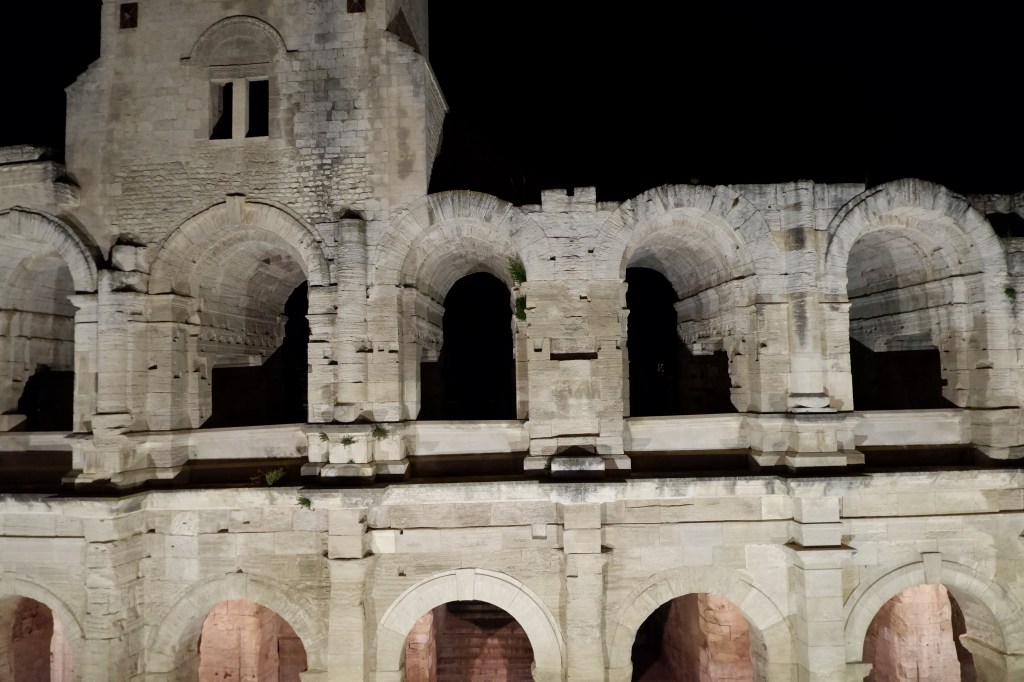
Ms Janneke, our hostess at the Airbnb that I had booked, recognised us immediately and whisked us off in her little rattly Renault, through the impossibly narrow cobble-stoned streets until we arrived at our home for the next week. I had forgotten how steep the stairs in such buildings could be, but once inside and we looked out of the window at the splendour of the 2,000 year old amphitheatre, I would have gladly climbed twice as many stairs. Right on cue from that thought, I realised that the same number of stairs, on the same gradient, were necessary to navigate to the bedroom and bathroom. Above our bedroom another flight of stairs led to a mezzanine level with a platform bed which we immediately nicknamed ‘Leonie’s room’. It was simply perfect!
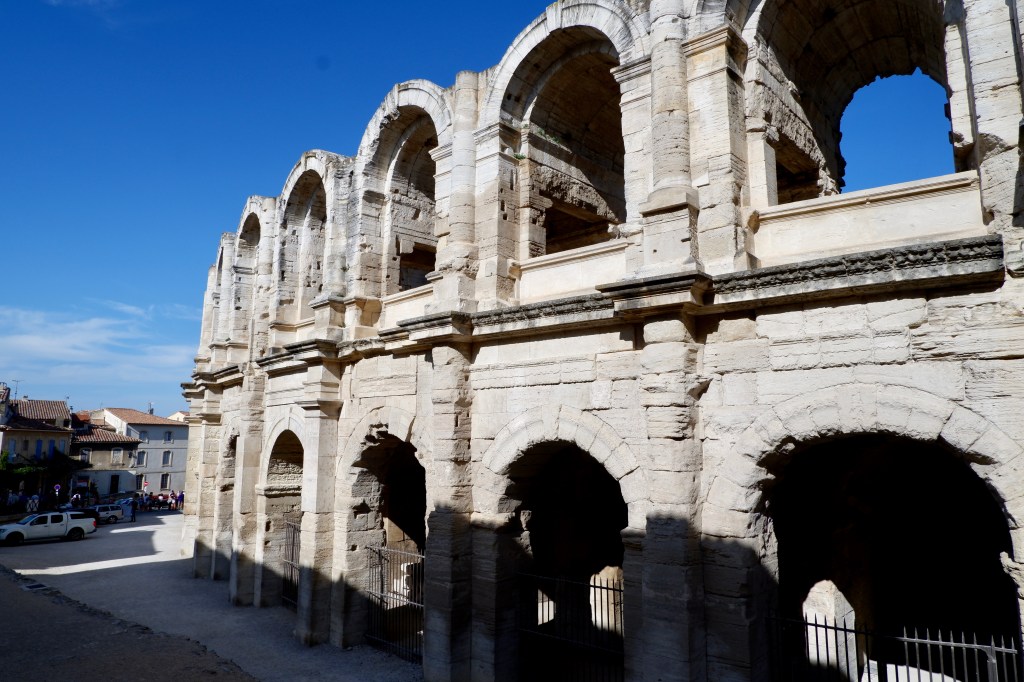
We wandered around exploring for several hours. Arles is a lovely small regional town with interesting, cobbled little streets, squares and fountains. Its colourful sun-baked houses inspired Van Gough who painted 200-odd works around the town. One of his paintings, The Asylum Garden, 1889, depicts a garden he painted while recuperating after he infamously cut off his ear. The same garden has been maintained and despite the growth of the trees, remains readily identifiable.
Most streets are closed to cars except for certain times of the day and with special passes. Bicycles, especially those weighted down by sleeping bags and supplies, are an occasional pest because they tend to travel in groups of two at least, but sometimes six or more. Other than that, in many ways it has all the hallmarks of a delightful quiet little French village. As it happened, we had arrived for ‘Roman Week’. Re-enactors of every age participated, soldiers marched up and down the little streets, ladies had a tent where they styled hair in the Roman fashion, there were demonstrations of weaving, weapon and jewellery making and the crowds were encouraged to participate in Roman board games. Having experienced the care and attention to detail of Viking Re-enactors, I could better appreciate the effort that this group had made with their togas (no, not simply white sheets), footwear and head gear. The entire town participâtes and even the shop assistants in boulangeries and supermarkets are appropriately attired. Clearly a lot of visitors had arrived to witness the event, but most of them were French speakers.
We enjoyed our first trip to the supermarket to pick up some supplies: water, wine, cheese, fruit and butter, located a boulangerie and looked forward to preparing our first breakfast in the morning.
22nd AUGUST, 2019 – ARLES
By virtue of our wonderful air conditioner, we had the best night’s sleep since leaving the ship in Stockholm. While Australia has been shivering, Europe swelters and hotels simply do not cater for temperatures in the 30s. This has been the first time that we have actually been able to manually control the temperature. So we luxuriated in sleeping late and then initiated what would be our morning ritual, to stroll down to the boulangerie, line up behind the other customers, order our baguette and croisants and then return to the apartment to eat it all with some freshly brewed coffee.
My research had informed me that it would take around forty-five minutes to get to Marseilles by bus. I had booked a car rental at Marseille airport which seemed to be the easiest option as we would drop it off there before flying back to Paris. My rudimentary French did not allow me to complete the more complicated task of ordering the car in Arles and returning it elsewhere. In any event, we headed off to the bus station to investigate timetables for the next day so that we could better budget our time. It was devastating when the young lady informed us that there were only two busses a day, that we would have to catch a total of three busses, and worst still, that it would be necessary to transit through Aix-en-Provence which was at least an hour travelling in the wrong direction. In other words, it would take the better part of the day to get there. My despair was short lived as I recalled that the train we had arrived in Arles with, terminated in Marseille.
We walked back to our apartment to regroup and cool off. Searching the rail timetable online, a wonderful realisation jumped out at us! The train to Marseille stopped at the airport on the way! Despite the debilitating heat, we realised that we needed to make the trek to the train station to confirm that was the case and to buy our ticket. On our way there, we heard a bugle playing the French equivalent of “The Last Post”. On the small square, just outside the old town walls, there was a ceremony taking place to celebrate the allied battle for the liberation of Arles on this day, 22nd August, in 1944. There were municipal officers resplendent in tricolour sashes, high ranking Officers of Police, and a contingent of French soldiers, proudly wearing the traditional peaked cap, the ‘Capi’. It was one of those poignant moments of fortunate coincidence, but one that made the hair on the back of your neck stand up!
We walked on to the train station where, in stark contrast, the girl at the desk was more helpful and very pleasant. We were correct in our understanding of the best way to get to the airport. There was no need to go all the way into Marseille. The train stopped at a little station 4 km from the airport, but a shuttle bus ran every 12 minutes! Added to that, as ‘seniors’ without having to show anything (except our weary countenance) we received a 25% discount!
With our rail ticket to Marseille Airport booked for 10.03am, we set our alarm for an ungodly 7.30am. That gave us time to make the obligatory trip to the Boulangerie for our breakfast of a baguette and croissants! While the labyrinthine streets of the Arles old town were intimidating at first, we were starting to feel a familiarity now, sufficient to allay any fear of being perpetually lost! We also knew we had rehearsed our trip to the rail station, and had noted how long it would take.
23rd AUGUST, 2019 – ARLES – MARSEILLES – AIX-EN-PROVENCE- PONT DU GARD – ARLES
After a relaxing breakfast of baguette, pastries and a wonderful strong cup of French press coffee, we set out for the station. It was still quite warm, but not yet sweltering. The second class cabin on the train was quite comfortable and not very crowded. But that didn’t stop people clamouring to get on board! We were fortunate to not have any luggage for once. Arles station isn’t designed for disabled access – nor for luggage! As we arrived at the station, we saw an old man well into his 80’s struggling along, aided by two ‘hiking’ poles, accompanied by his middle-aged son. When the train pulled into the platform, he made his way to the same carriage as us, with its difficult three-step climb. We stood back to help him up. But, at the same time, a thickset woman tried to push past me – and the old man – from the side! I was having none of that! I reached out my arm in front of her and grabbed onto the door’s handrail, blocking her path! We saw the old man to his seat, totally bewildered by the lack of respect and consideration that had been shown.
The trip took under 40 minutes. The shuttle bus arrived in about 10 minutes and took us to the main terminal. We soon found the Europcar office. The office seemed to be quiet and there were only 2 or 3 people ahead of us being served. We were attended to by Lilian (a very helpful young man). Inadvertently, our booking somehow defaulted to selecting a ‘manual’ car. Having had the nightmare of a left hand drive manual car once before, we wanted to change the booking to an automatic transmission. In Europe, the norm for rental cars seems to be manual gearbox. But, of course, an auto was going to be an ‘upgrade’! Equally, having a navigation package was yet another upgrade. Then too, ‘no excess’, another upgrade. Finally, we were offered a new sporty ‘Mini’, but with our bulky, heavy luggage, that was never going to work!! The next upgrade was a huge jump but, in a classic “bugger it!” moment, we took the beautiful black BMW 420i M4 convertible!! It wasn’t such a bad choice really, as we drive a BMW at home and, apart from LH drive, it has exactly the same controls.
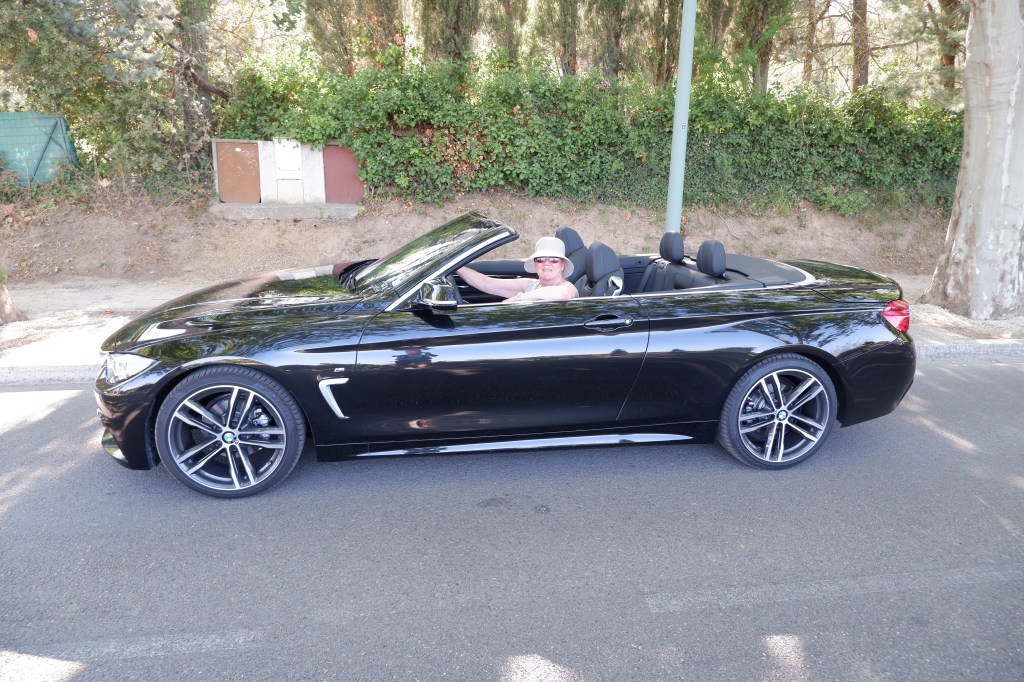
We programmed the navigation (with some difficulty!) to take us to Aix en Provence. It wasn’t an entirely successful programming as it kept wanting to default to an unwanted series of ‘Aix’s’. In frustration, we eventually gave in and selected one of them. It proved to be to the local airport!! Nevertheless, we eventually made our way to the outskirts of Aix en Provence. But where to from there? We followed signs to the centre of Aix ‘Ville’. Only by chance, near the centre, we saw a sign to an underground parking lot. Down we went! The downward winding passageways were impossibly narrow and obviously not intended for such a large car as we’d extravagantly chosen! Added to that, it was quite full and there were almost no vacant spaces. Even to call them ‘spaces’ at all is something of a misnomer. They were all barely wider than a small average car and if someone parked crookedly or had encroached on your space, you couldn’t possibly fit into them anyway! Finally, we found one wide enough.
With a sense of relief, we walked out into the daylight. Aix en Provence is a beautiful city with wide tree-lined streets, grand fountains and eye watering architecture. The narrow walking streets are visually stunning, lined with the highest quality fashions, perfumes and every description of luxury goods. After our early start and exhausting drive, we needed refreshnent. In every small square, there were restaurants and cafes with tables under vast awnings or umbrellas. Everywhere people were enjoying the atmosphere, the food and the visual delights. There were very few free tables. But we finally found a table at a wonderful Boulangerie and ordered coffees and a Millefeuilles fraise (like a vanilla slice with strawberries in the custard – an inadequate description of what is truly a pastry masterpiece!).
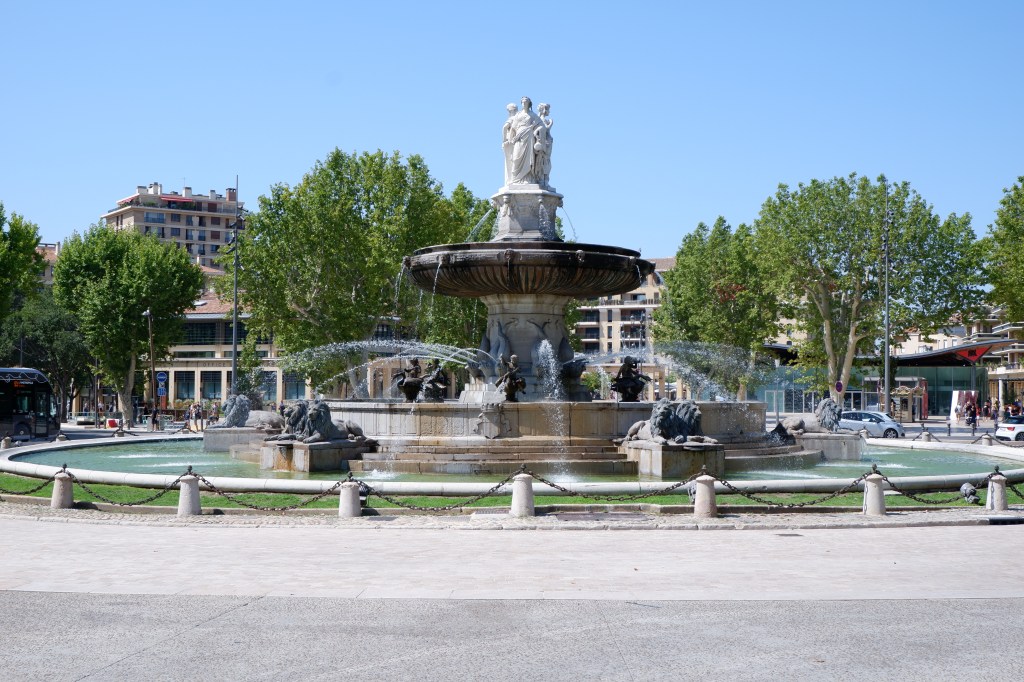
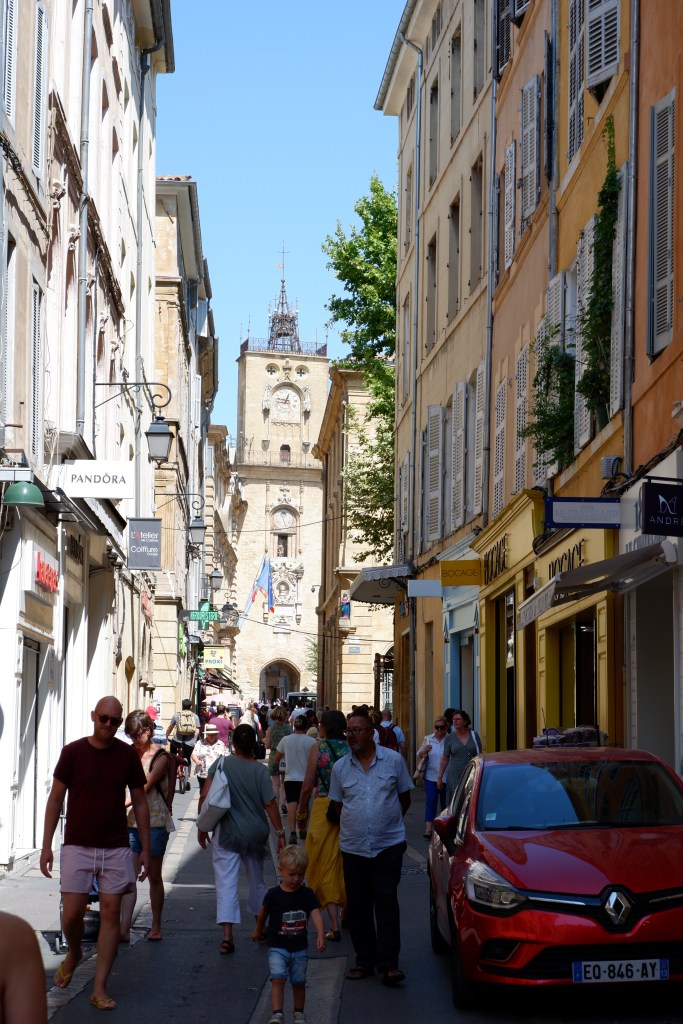
There was a Modern Art museum nearby that I’d hoped to visit. Musee Granet houses some wonderful works of Rembrandt and Renoir as well as numerous Impressionist works, most notably Cézanne . Google Maps indicated it was about 3 kilometres away, so we decided to go by car. As we later discovered, it was actually only about half a kilometre from us! But once back in the car, using the navigation to guide us, we were funnelled into progressively narrower and narrower streets, edged by bollards on one side and awkwardly parked cars on the other! Then, arriving at a spiderweb of intersecting streets, with the navigation lady commanding, “turn left now!” while impatient drivers were tooting at us and gesturing it was a ONE WAY street! We had no option but to give up! As soon as we could find a place to pull off to the roadside (there are almost none!) we re-set the navigation to take us to the Pont du Gard. At 50 m in height, this aqueduct is the tallest remaining Roman ruin in the world.
After the labyrinth of Aix, it was a pleasure to drive out on open roads again. However, on the flowing autobahn style highway, we were soon confronted with a 12 lane wide, toll barrier. Cars and trucks fanned out to take any available lane. We had absolutely no idea what we had to do. As we sat in our lane, we watched those ahead of us for a clue of what to do. Some were plainly struggling and that gave us no encouragement. When we arrived at the barrier, expecting to pay, there was a machine with a ‘take a ticket’ symbol above a button, just like entering a car park! Still not being quite sure how to pay, we took the ticket … and the boom gate lifted! Mystified, we drove on. At the other end, at yet another multi-lane toll barrier, we inserted the ticket and when the toll Euro amount displayed, we tapped our credit card. It was simple in the end, but not knowing what to expect can be frightening.
On the lesser roads, roundabouts abound, many of them having multiple exits leading off them. The navigation lady did her best to tell us where to exit but, unavoidably, we sometimes got it horribly wrong and had to backtrack. How you could do this without a navigation system just beggars belief!
We got to the site of Pont du Gard at about 4pm. The temperature was 33 Celsius, but it seemed much hotter. The site is a National treasure and like all monuments, has an entry fee to visit it. This is a site that has to be seen to be believed. Like many of the World’s wonders, photographs alone cannot begin to capture what the eye can take in. Roman engineering is simply breathtaking! The thought of how it was constructed, the rugged location in which it was constructed, how the massive stones were quarried and transported, and how the rough sandstone was worked into the complex shapes needed, is almost incomprehensible!
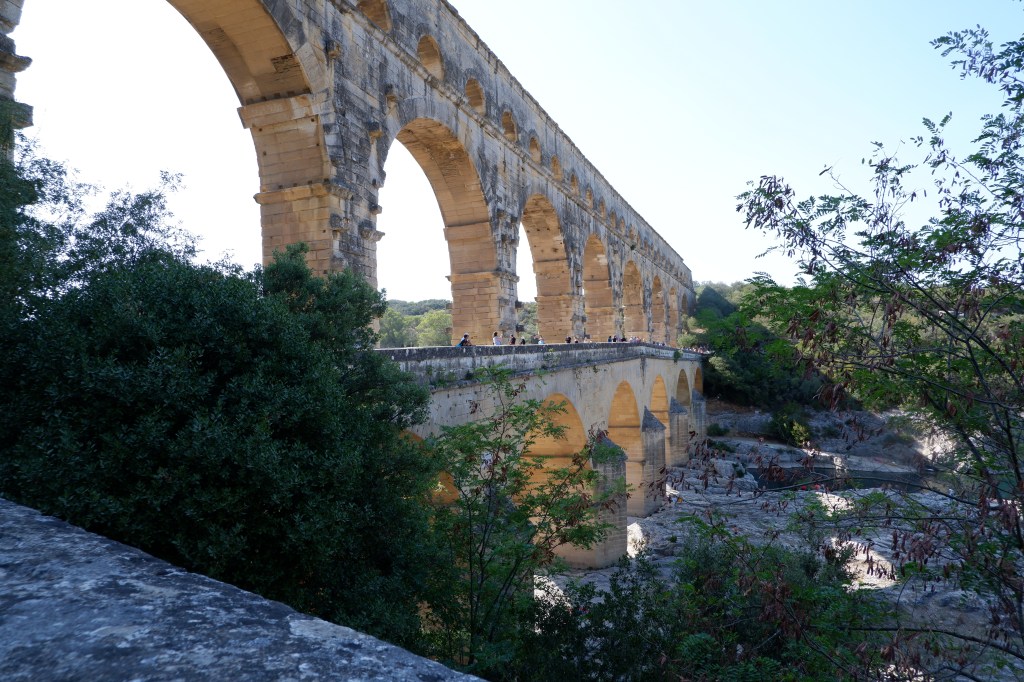
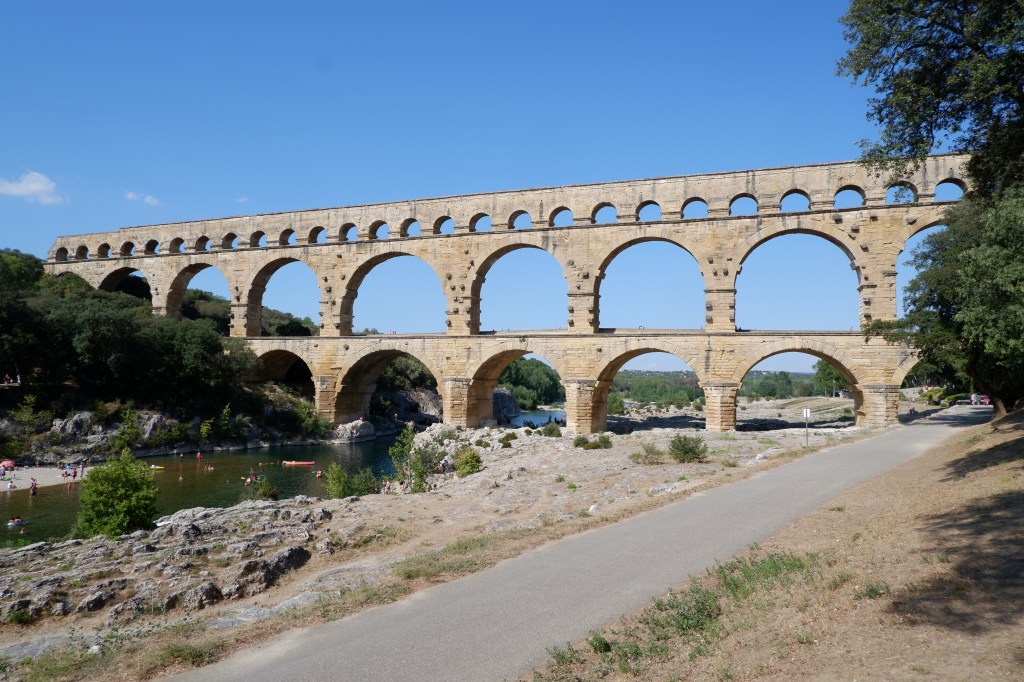
After re-hydrating at a open air restaurant within the site, thankfully cooled by large fans and misted water sprays, we returned to the car. Oh, the joy of an air conditioned car! It took us over an hour to return to Arles. We had programmed the navigation to take us to the car park just outside the old town walls. It was a relief to be guided right to the ‘in ramp’! However, once again, the impossibly tight turns within the structure, with concrete walls showing deep scrapes and gouges at every turn, made it a white knuckle moment. Again too, the spaces themselves were quite small! No damage was done, but we were glad to have opted for ‘no excess’!
It was only a short walk back to our apartment, with just enough time to get ready for our dinner at “Le Piques ou Rien”, a degustation menu, where you simply accept to eat what they serve you. When we booked a table, they took time to ask if we understood the philosophy of the restaurant. The entree wasn’t as dramatic as we had expected. It was simply a mixed platter of charcuterie, cheese and olives. The meats were highest quality cured meats from Italy, Spain and a local speciality, Bull Sausage. However the following courses were more in the nature of a degustation. A cut of beef that we didn’t recognise, but delicious and cooked to perfection! But, most interesting of all, we sat outside the restaurant in the square surrounded by other restaurants. There was music playing from one, a vocal, busking acrobat was working the square, performing continuous somersaults and feats of the greatest athleticism. Next door, at a small art gallery, the owners, an elderly couple, transported straight out of the sixties, sat outside at a small table, drinking wine from a ‘teapot’ and eating their dinner al fresco. It was great people watching. All in all, it was a great end to a very full and exciting day! Afterwards, back in our apartment, we slept soundly in our air conditioned bedroom, thoroughly exhausted!
24th AUGUST, 2019 – ARLES – GORDES – ARLES
After the marathon driving effort of the previous day, the one hour trip to Gordes was a breeze. We drove through the lovely countryside, through fields of the sunflowers that inspired many of the Impressionist artists that came here to paint, olive groves, vineyards, fields of cherries, pumpkin, corn, cabbages and broccoli. As we approached, Gordes we started to notice the incredible dry-stone fences and buildings. The craft of those bygone masons has hopefully been passed on because most of these structures appear to have been around for centuries.
Gordes is one of the most well-known hill top villages in the region and by popular opinion, one of the most beautiful in France. It’s houses and buildings of white and grey perfectly preserved stone, root themselves into the sharp cliffs of the mountain and the village itself has a labyrinth of narrow, cobble-stoned alleys, that meander around and through it. The imposing castle that dominates the village dates from the 10th century and was remodelled during the Renaissance. Incredible insecurity born from centuries of invasions, forced the people of the countryside to seek refuge on the fortified heights. The strategic importance of controlling access to the Cavalon valley below led to it being occupied from prehistoric times, through to Roman times and the Middle Ages and during the Second World War, Gordes was a centre for resistance fighters against the occupiers. The Panorama of the valley against the backdrop of the Luberon Mountains, is just one more on the incredible places we have visited that simply must be experienced because mere photography cannot do it justice.
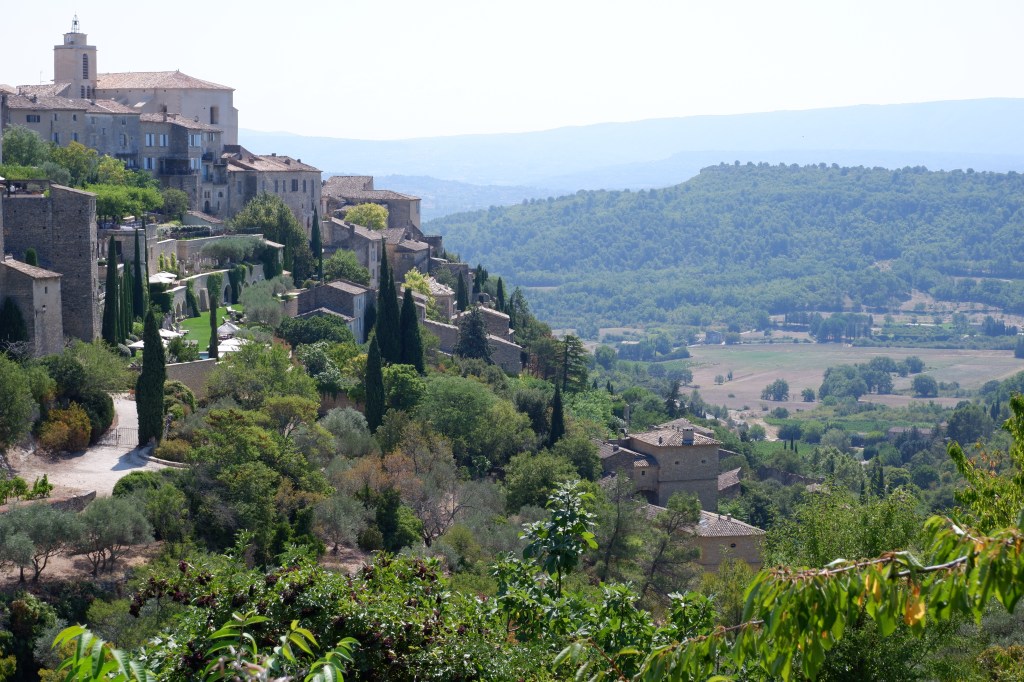
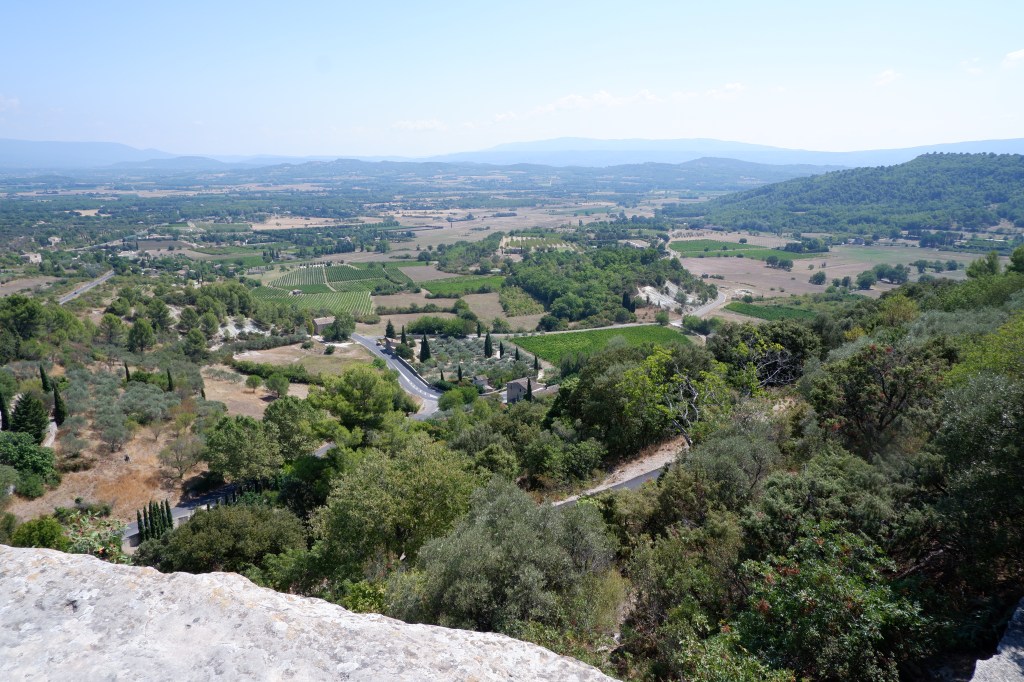
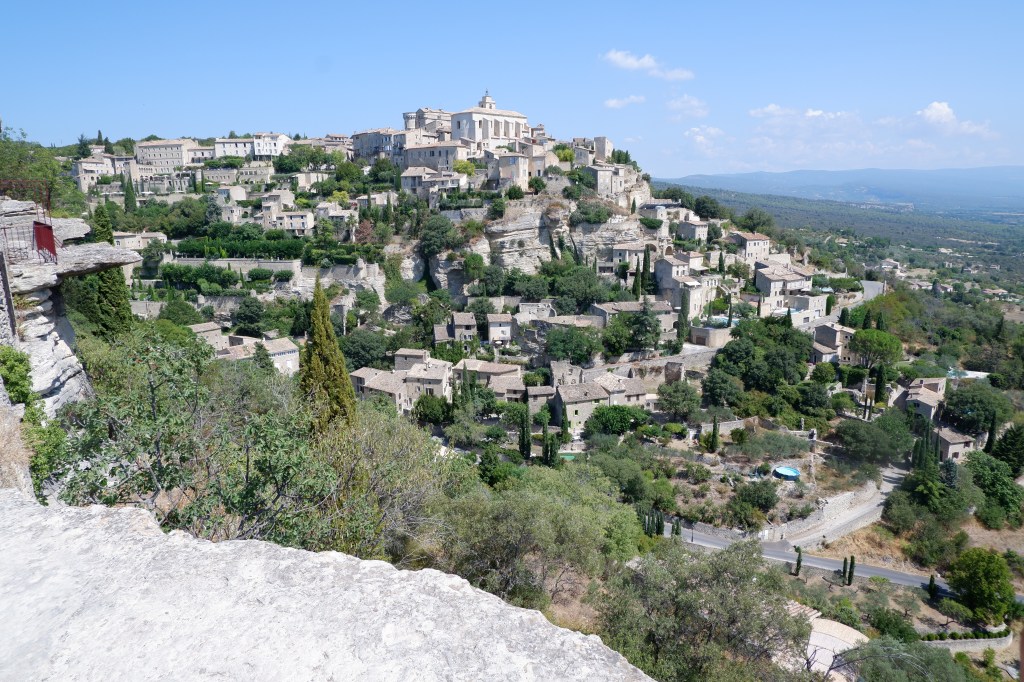
Parking proved to be extremely difficult but the good fortune that inevitably clings to us endured. Yet we were unable to ascertain whether after the first thirty minutes our credit card would be automatically charged or if we would be fined if we stayed longer. My risk taking persona melded with Barry’s conservatism and we stayed forty-five minutes. By a happy coincidence, just as we began our descent from the village we found a rare viewing vantage point. With the aid of some vaseline, Barry was just able to squeeze into the last of only about six parking spots, so we managed to spend more time and enjoy a slightly different view. The sight of a group of young picnickers sitting nonchalantly with their legs dangling over the ledge of a precipice sent a surge of vertigo washing over me and I needed to get away.
It was lovely to get ‘home’ early enough to just flop for a while. The interminable heat saps our strength and our air-conditioned sanctuary has a magnetic pull. We look admiringly out of our windows and feel no need to do anything but appreciate the splendour in front of our eyes. After resting for a few hours, we showered and dressed for our dinner reservation at Le Criquet. On our way to dinner we strolled around town looking at the various locations famously painted by Cezanne and Van Gough who so loved the light in Arles. After Van Gough infamously cut off his own ear, he was hospitalised in Arles. He painted many works while convalescing and after being placed in a ‘mental’ asylum. The setting for the ‘asylum garden’ has been faithfully maintained as evidenced by our photograph compared to his artwork.
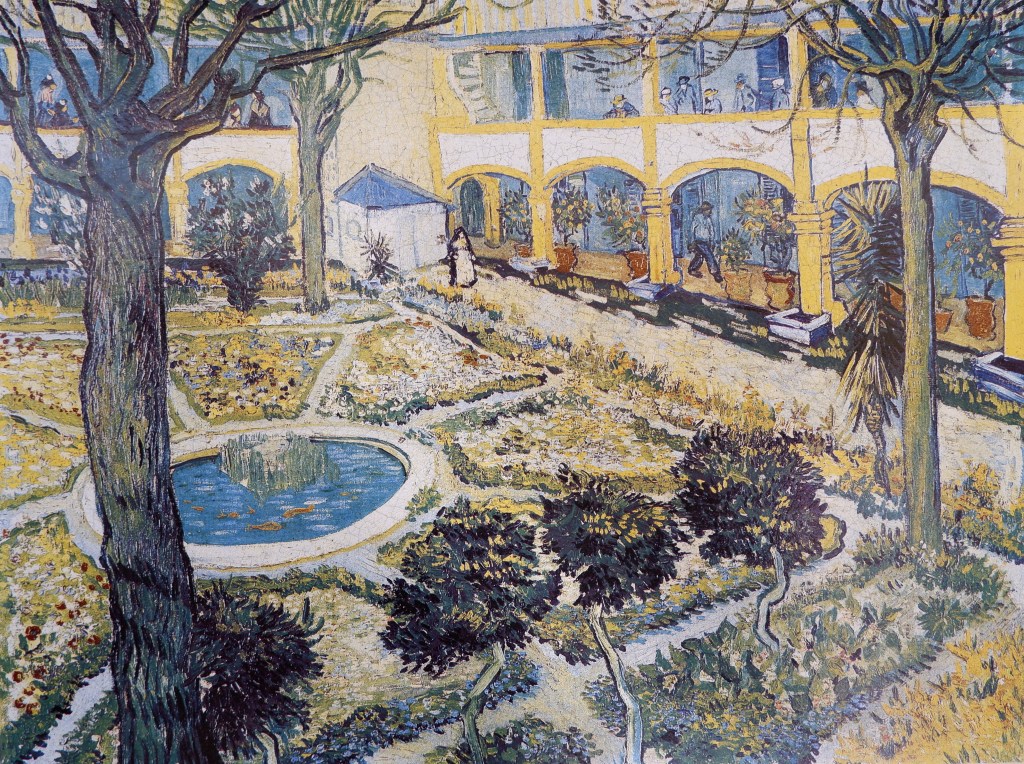
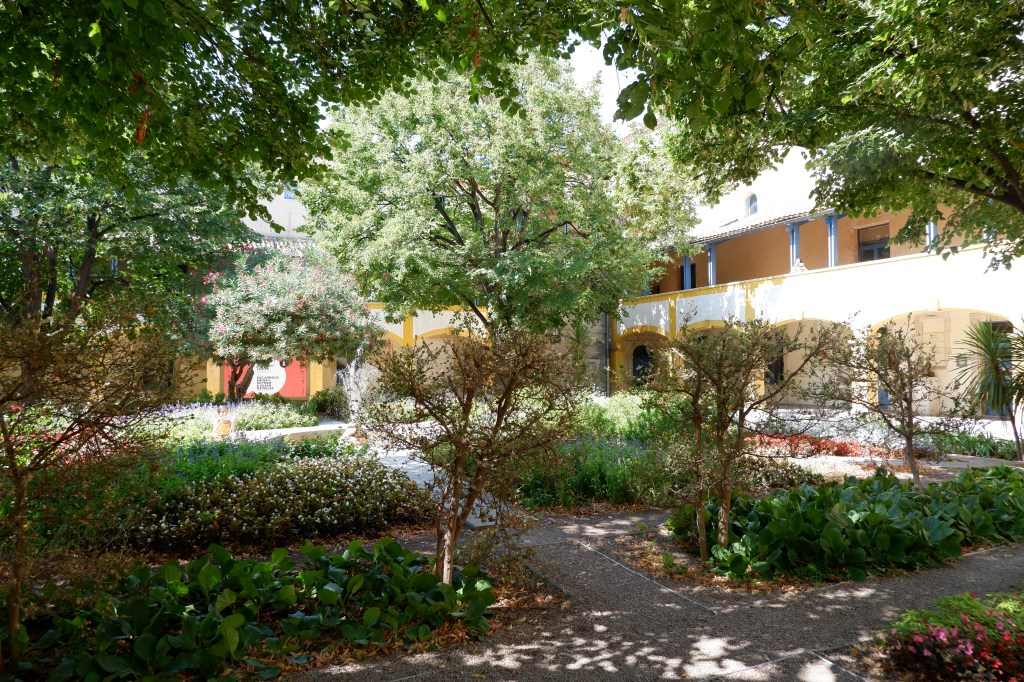
Dinner that night was a wonderful experience! In Paris, my stumbling French was often met with an automatic transition to English. As the days and weeks pass, my French becomes more confident, and I suspect more than that, in the South of France there is a more laid back acceptance of the non-French and an appreciation of efforts made by the ‘other’ to communicate in their own language. So in all the time we have been here, every shop assistant and every restaurant worker has allowed me to stammer on, without correcting me or breaking into English, and best of all, I am completely understood! Le Criquet epitomises this approach. The two beautiful and charming young women who run the place, flatter me by not slowing down their banter one iota. Not only that but the food was sublime! Barry had octopus salad followed by lamb. I had fish soup (like an unbelievably good strained bouillebaisse) followed by fish of the day cooked to perfection. I am loving the food in France so much that I fear that I am succumbing to gluttony.
25th AUGUST, 2019 – ARLES – NIMES – ARLES
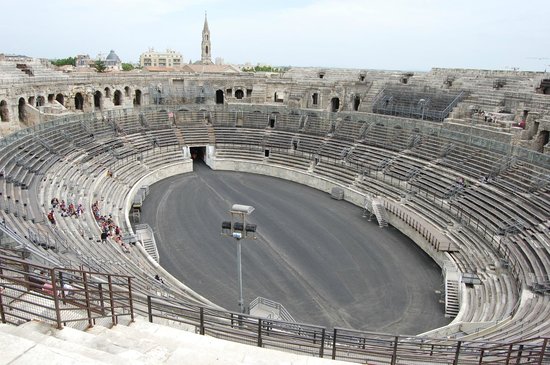
I had chosen Arles as a base primarily for its proximity to the Roman antiquities that Barry loves so much. Today as we headed off for the forty five minute drive to Nimes, I had no real preconceptions. I knew that like Arles they had relics of an arena and a temple, if not much else. Boy was I in for a surprise. First of all it is a thriving city, more reminiscent of Paris on a smaller scale than the village-like atmosphere of Arles. Then, of course, there were the ‘relics’. The amphitheater in Nimes is the most intact Roman arena in the world, 20 metres high, and still used for concerts and bull fights. Although banned in Spain, bull fighting is still enthusiastically pursued in France. It has been deemed a cultural tradition and no amount of protest from animal rights enthusiasts has changed the opinion of government or the general population. We spent some time at the arena and discovered many interesting facts about the gladiators that neither of us had previously been aware of. This trip, like all international travel, has proved educational in so many different ways.
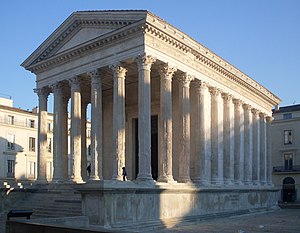
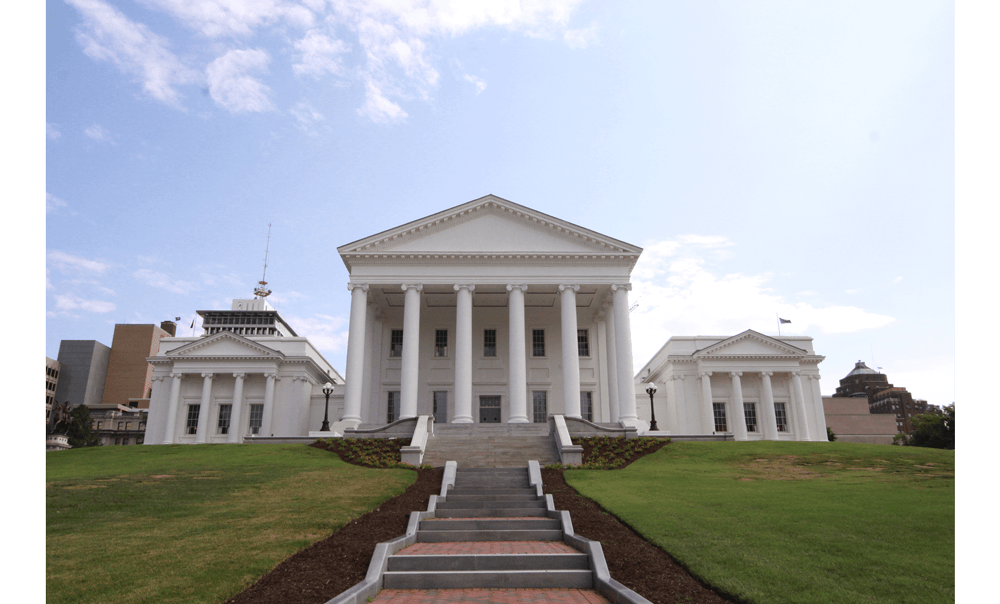
Similarly, we were impressed at our first viewing of ‘Maison Caree’ (square house), the best preserved Roman temple in Europe, with extraordinary visual appeal. We were not alone to feel that way and we discovered another fascinating historical fact. In 1787, the then Minister to France, Thomas Jefferson, travelled to Nimes. Jefferson believed that architecture is foundational to the taste of a nation and that America was in dire need of public buildings that sent the right message. Aping the palaces of Versailles or St Petersburg would be wholly inappropriate for the fledging Republic. So Jefferson turned to antiquity for models of uncorrupted by Royal extravagance or gothic exaggeration. A comparison between the Virginian Capital Building and Maison Carrée shows an undisguised similarity.
As we were to have six o’clock start in the morning, we had originally planned to have a picnic dinner in the apartment. However, we had been so impressed with Le Criquet the night before that we changed our minds and returned there for another sumptuous meal instead.
 maryannsholidays