26th AUGUST – 3rd SEPTEMBER, 2019
We left Arles at 7am for the drive to Marseille airport for the 10am flight to Paris. The drive was relatively free flowing until the outskirts of Marseille when it began to slow to morning peak hour crawl. We returned the BMW and made our way to the terminal. When we arrived at Orly airport we organised our next hire car, a ‘DS 3’, a derivative brand of Citroen. From there we faced the usual stressful labyrinth of roundabouts, incomprehensible junctions and multiple-choice off ramps. Eventually, we escaped to the tollways and headed for the Loire Valley.
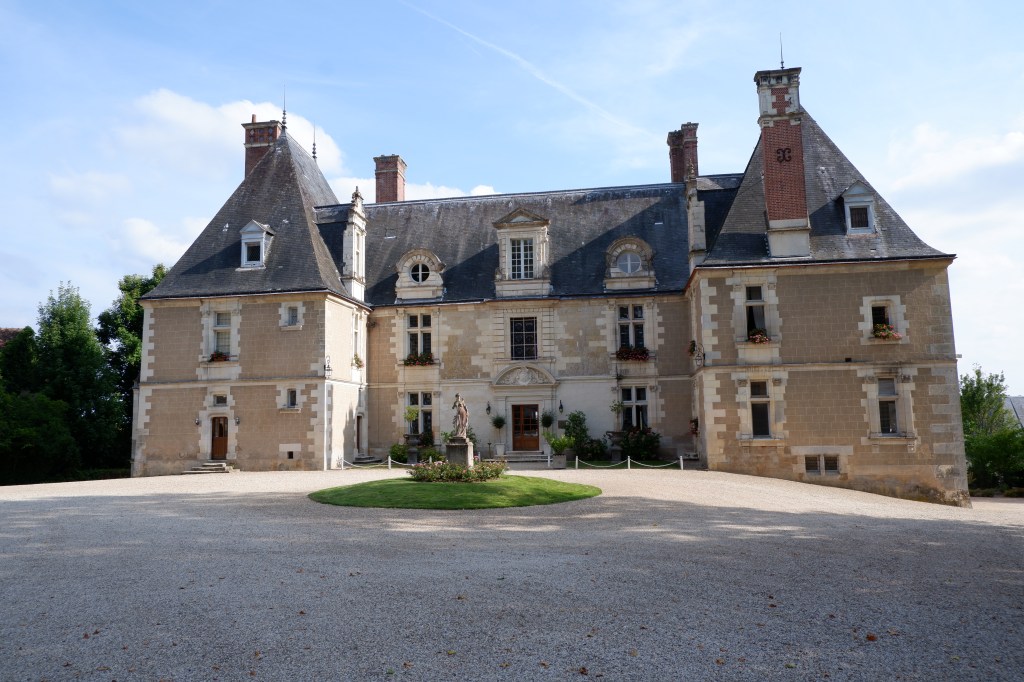
The first Chateau we had booked to stay in was a 15 minute drive out of Amboise, in Noizay. We drove through the almost totally deserted, narrow roads of the village of Noizay. Following signs to ‘The Chateau’ we drove through an impressive main gate and along a tree-lined driveway that opened out onto the forecourt of the Chateau. As our first Chateau, it was immediately impressive and imposing to us. However, as time went by, there was something of a ‘Fawlty Towers’ feeling to the place! Sitting at the tiny reception booth most often, was the ever-smiling, ineffectual young lady, dressed completely in black, who was never able to resolve any issue for us, or answer any question (the ‘Manuel’ of the establishment). At other times, it was the Chateau’s owner, an impeccably-dressed mature woman, with her strained frozen smile and surly disposition, taking her front-of-house demeanour straight from Basil Fawlty! There was never the slightest issue (which she immediately assumed was a complaint) that she didn’t have some well rehearsed and, no doubt, oft repeated excuse for! The many reviews we read later attested to this unfortunate characteristic. Overall, our experience was a positive one. The bed was comfortable and the room spotlessly clean and maintained. But there was a sense of miserliness in some aspects. One example was the minibar. A small bottle of water, that everywhere else was complimentary, was €7.50 and a tiny 5ml bottle of gin was €10 (when a 700ml bottle cost only €20 at a store). Breakfast wasn’t included in the tariff and, at €25 per person (a total of around A$75), we opted to take our coffee and croissant in Amboise for less than €10 for the two of us.
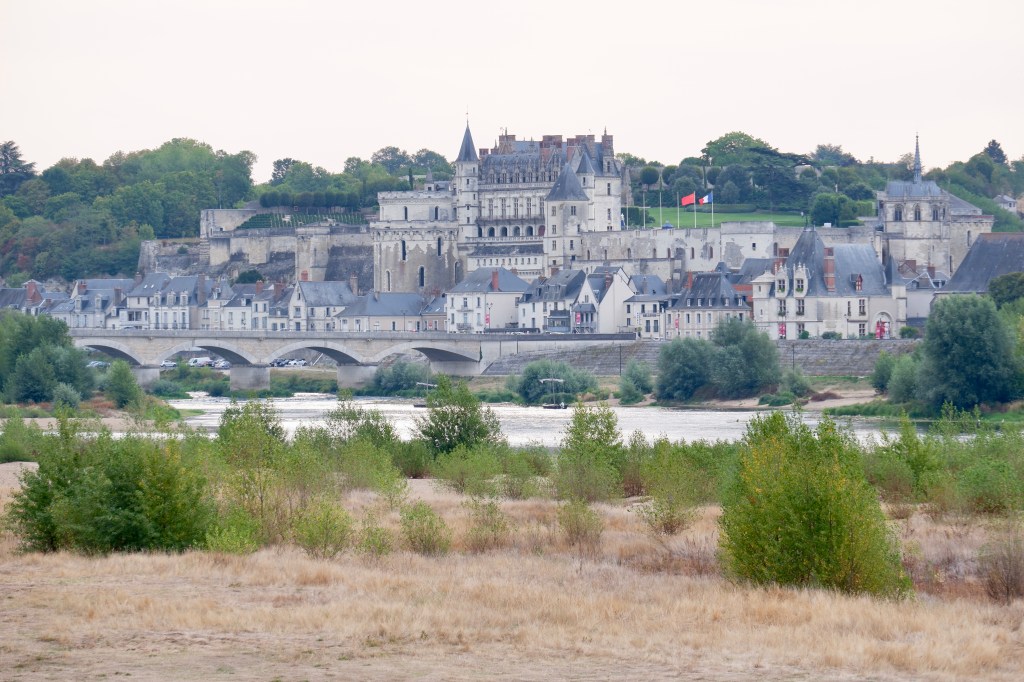
Amboise quickly became our favourite French regional city. It was large enough to have every kind of business and service you could need, yet small enough to immediately feel at home and comfortable in. It is a beautiful city with a castle atop the hill that overlooks the Loire River. It is exactly the kind of place we’d consider staying at as a base, if we decide to return to visit for a month or more. It was love at first sight when we rounded a corner next to the river and gasped aloud at our first glimpse of the Amboise Chateau towering over the village.
We especially loved the wines from the Vouvray region around Amboise. We took a wine ‘education’ tour on one of our days in Noizay run by a personable English couple, Cathy and Nigel who had lived in the Loire Valley for 12 years. Previously she had been a wine salesperson in the UK, while Nigel had been a farmer and viticulturalist, so they were eminently suited for this career path. The next day, while exploring on our own, an hour’s drive from Amboise was the picturesque Chateau Chenonceau. We arrived there at about 4pm. Visiting early in the morning or in the late afternoon is advised. However, the place was literally teeming with people. The parking areas, for busses and for cars were completely full. Fortunately, someone pulled out of a space as we approached. But once out of the car, it didn’t take us long to decide to forego the visit.
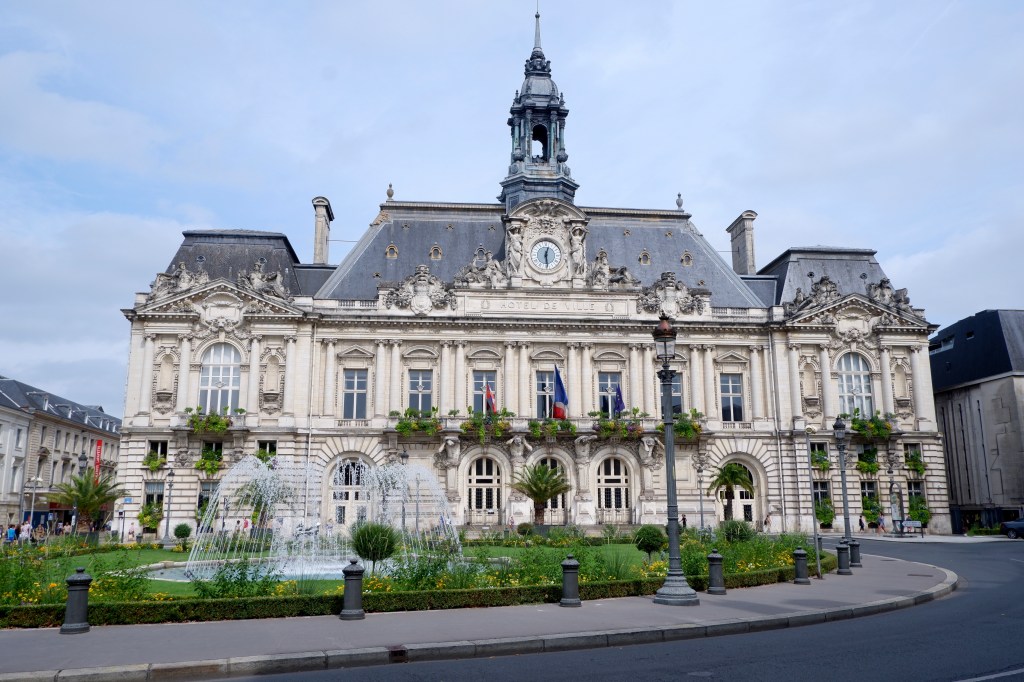
From Amboise it was only about half an hours drive to Tours. I had been excitedly anticipating a visit to the Musee des Beaux-Arts to see Rubins ‘Madonna and Child’, not to mention the Degas and Monet collections. Sadly, we arrived on a Tuesday, the one day they were closed. Yet the architecture was always available for public viewing and we strolled around agape at the beauty of the grand, semicircular Place Jean Jaurès, adorned with fountains, formal gardens, the Town Hall and the Courthouse. The Cathédrale St-Gatien, with its flying buttresses, gargoyles and twin Renaissance towers made the visit worthwhile all by itself.
On our last night in Noizay, we had booked to dine at the Chateau. The ineffectual smiling girl greeted us and led us to a table near noisy children. When we asked for a quieter table, she walked us into an adjoining dining room, past a table for two, and offered us a table set for four. It seemed odd, but it was the quieter kind of place we’d asked for. It was only after the first course that it dawned on us that we were at the only table without a tablecloth. We asked the waitress (a woman with a severe and serious countenance) why we were at such a table when a properly set table for two was right next to us, she said, “The people for that table had a reservation!” We said, “But we also have a reservation!” Then the young girl approached. Her explanation was, “That was the table you chose!”. Then, finally, the stone faced Chateau owner, having consulted with both of the others, came and offered us the table for two, saying, “These people haven’t come for their booking. You can sit here.” But, despite the strange table arrangements, conflicting excuses and slow service, the meal itself was excellent.
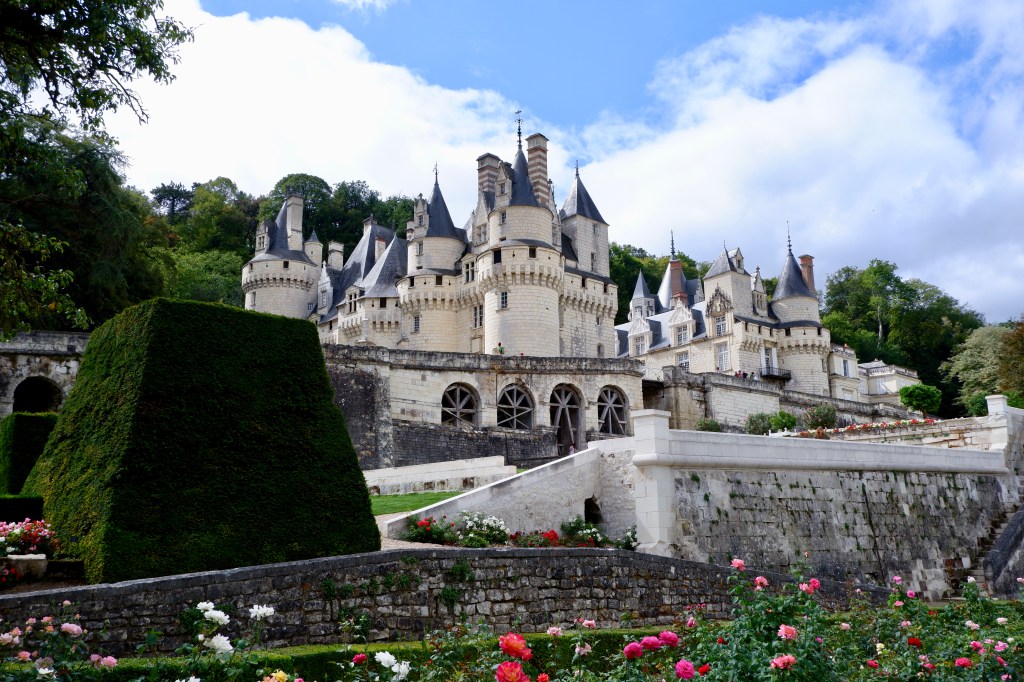
Our next stop was in Saumur, a two hour drive away. We breakfasted in Amboise one last time, then set off on our drive through the French countryside. On our way to Saumur, we stopped by Le Chateau d’Usse, the inspiration for Charles Perrault’s classic fairy tale, known in English as ‘Sleeping Beauty’. At first sight, emerging from the narrow winding village road (thankfully too narrow for tourist busses to navigate) the Chateau is spectacular. Creamy white towers and slate roofs jut out from the edge of the forest of Chinon and, as you get closer, absolutely glorious and well maintained garden areas surround it. Some people feel the co-opting of the fairy tale by way of stage sets with mannequins depicting various scenes from the story is a bit tacky, but I actually loved it. I clambered up the tower steps with excited little girls dressed up in their princess dresses and read aloud the English translation of the story before rushing up some very steep steps to the next floor to see what happened next. Getting to the top afforded sweeping views of the flat Loire countryside and the presently, all but dried up, Indre River.
We arrived in Saumur at about 2pm, still too early to check in to the Chateau De Verrieres, so we drove up to the fortified castle atop the hill overlooking the city. Château de Saumur also has a fairy tale look about it. It soars above the town’s rooftops and was built in the 13th Century by Louis XI. It has served variously as a fortress for protection against the Normans, a Renaissance palace, a Protestant stronghold and an army barracks. By 3pm we had seen and photographed as much as we wanted. We re-set the navigation to take us to the Chateau, thinking it was a considerable distance. It proved to be in the middle of a residential area, quite close to the ‘old town’, only a five minute drive from the castle.
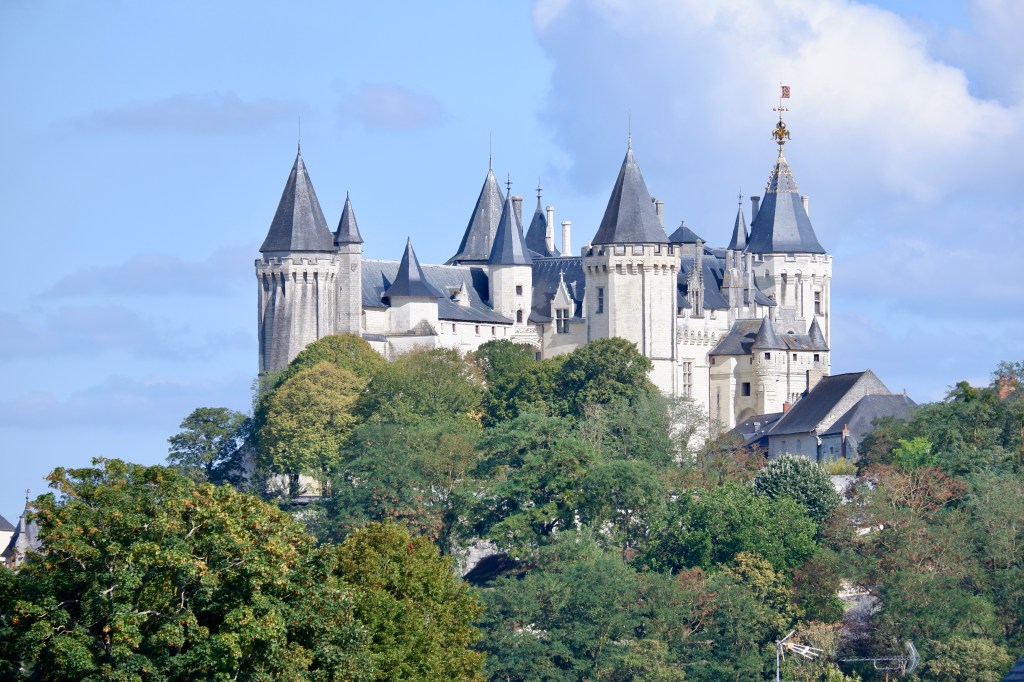
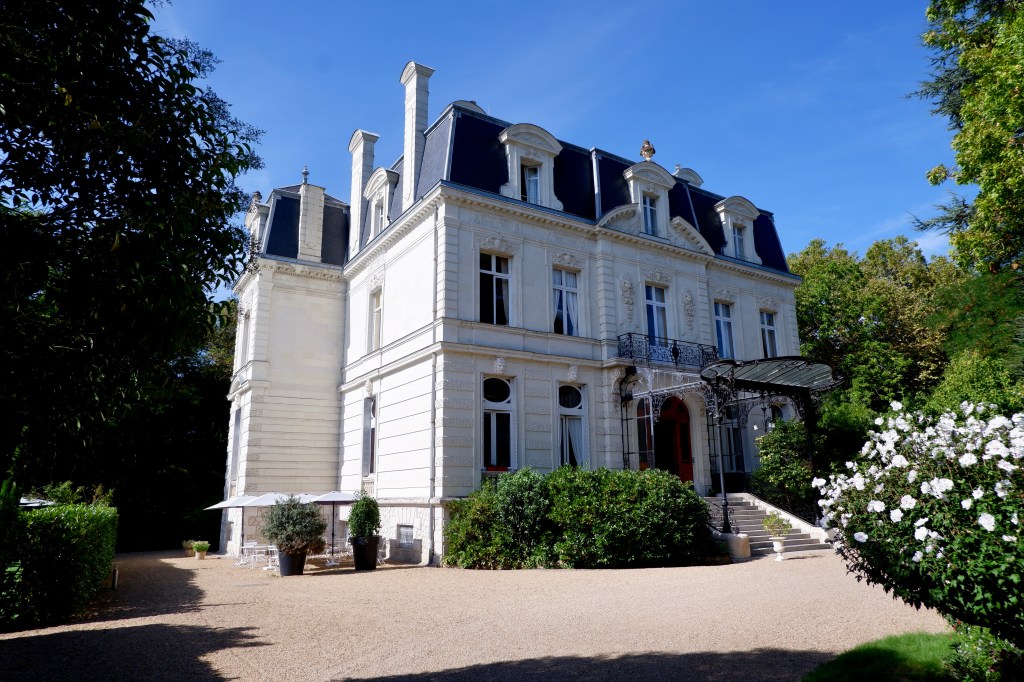
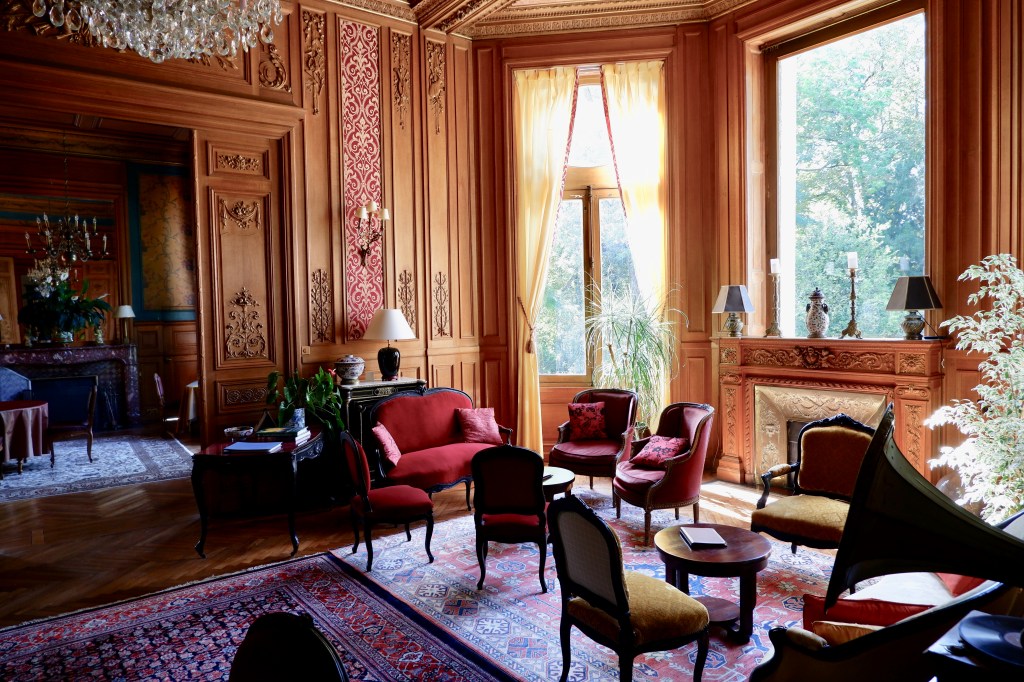
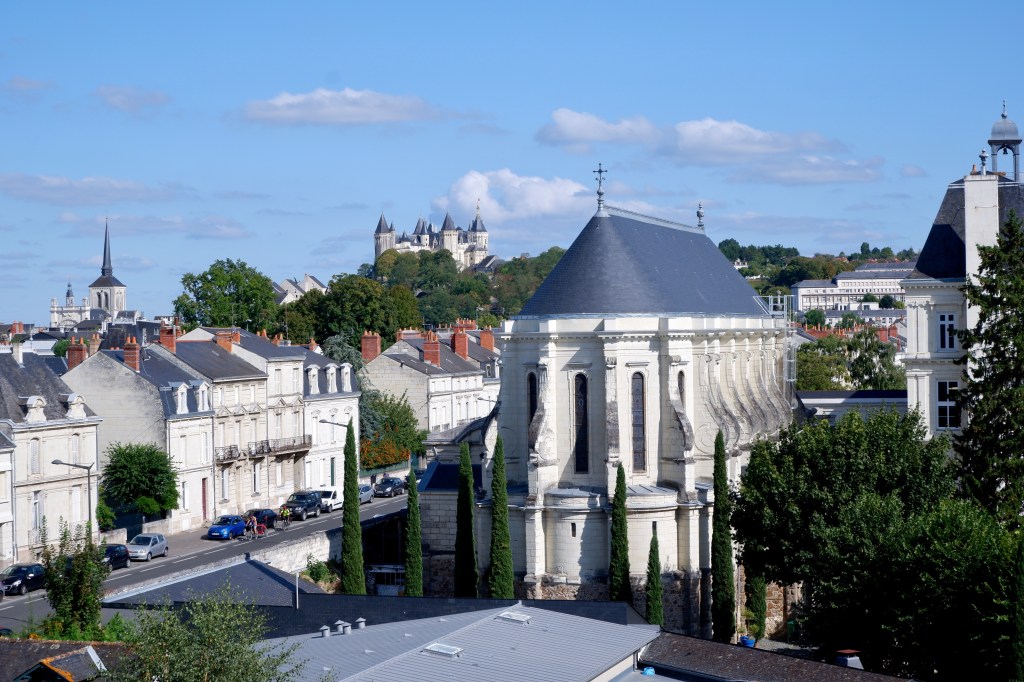
After Chateau Noizay, the Chateau De Verrieres was truly magnificent! With wood panelled salons, marble fireplaces, original artworks, antique writing desks, Persian carpets and the most ornate heavy oak winding staircase that I’ve ever seen, The grounds, just like the interior, were immaculately maintained. The staff, too, were absolutely charming and welcoming, in complete contrast to what we’d had for the past three days. It was to become our favourite accommodation experience in France. The room we had was newly refurbished, large and impeccably furnished. It even had an air conditioner, albeit a portable unit. Best of all was the most astonishing view over Saumur’s Chateau, I could hardly pull myself away from the window!
That first night we hadn’t booked a restaurant. The concierge suggested a restaurant on the old town square. It was an excellent recommendation. The square was packed with local residents and almost every table was occupied. The Chateau had made a reservation for us. The meal was surprisingly good for a bistro. We were more than satisfied!
Next morning, we went down to see the breakfast fare at the Chateau but we didn’t want anything more than a coffee and pastry. Knowing that the old town square was so close, less than a ten minute walk, we opted to breakfast there, as we’d done in Amboise.
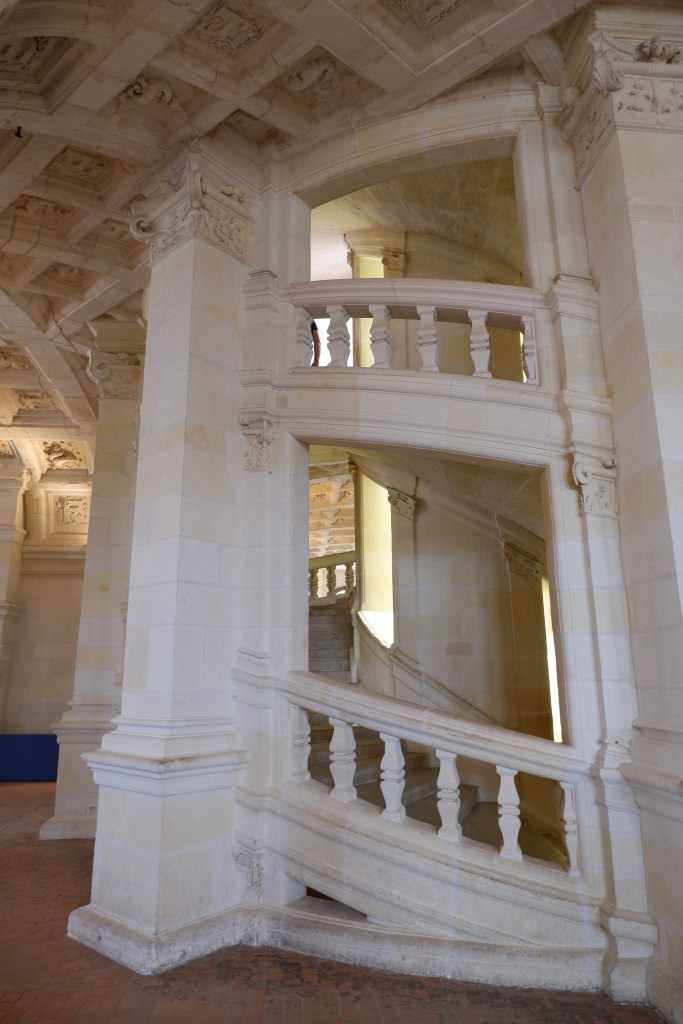
On our last night in Saumur we splurged on Michelin Star restaurant. La Gambetta served us an astonishing seven course degustation menu with matching wines and extra little taste teasers sent out from the kitchen. We are quick to criticise those people who have a need to photograph every morsel that they consume on a two week holiday, but we really couldn’t resist sneaking a quick photo as a memento of this incredible gastronomic experience. So we have Ambroise as our favourite French town, Chateau de Verrières as our favourite Chateau accommodation and now La Gambetta as our favourite restaurant. We have now spent ten days travelling in the Loire Valley. It is hard to pick a favourite Chateau because so many of them have special characteristics. Amboise is spectacular for being an integrated, medieval city which is stunning to view as you approach it with the Chateau sitting magically above the river. Similarly, the Chateau of Saumur sits proudly high above the city with its slate roof and spires above the cream structure. Yet for sheer opulence and genius design (no small thanks to Leonardo and his double helix staircase), if you only visit one Chateau, visit Chambord!
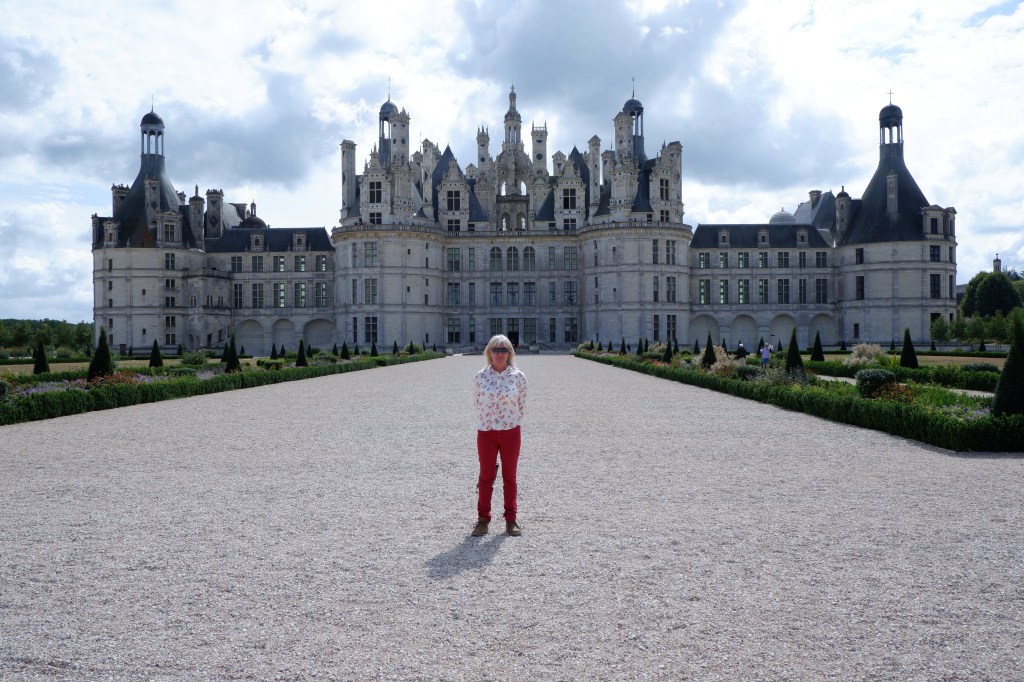
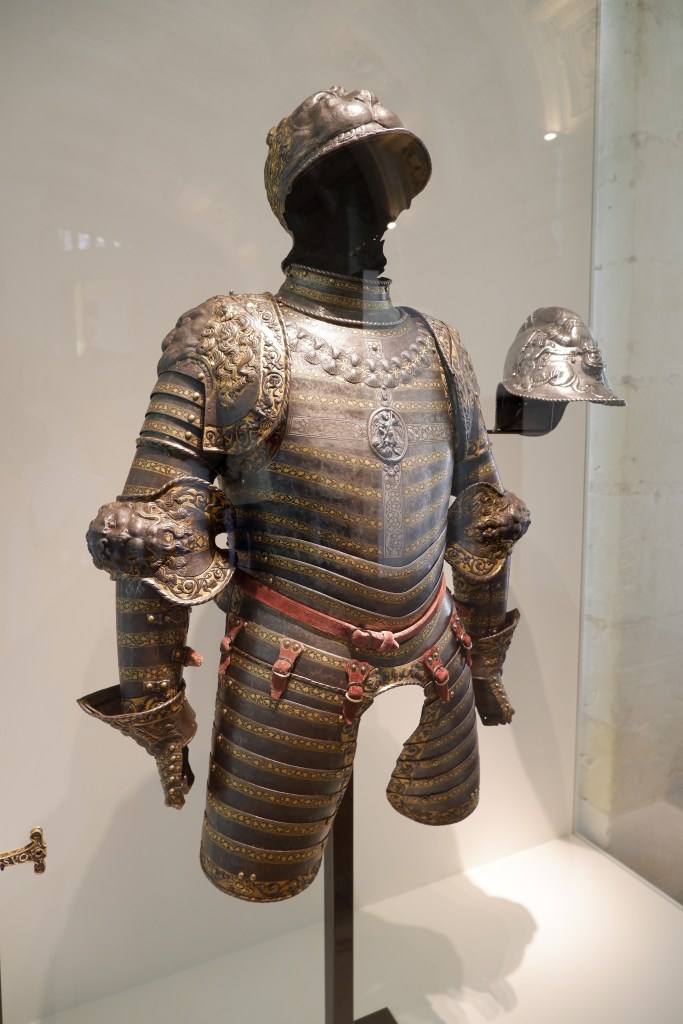
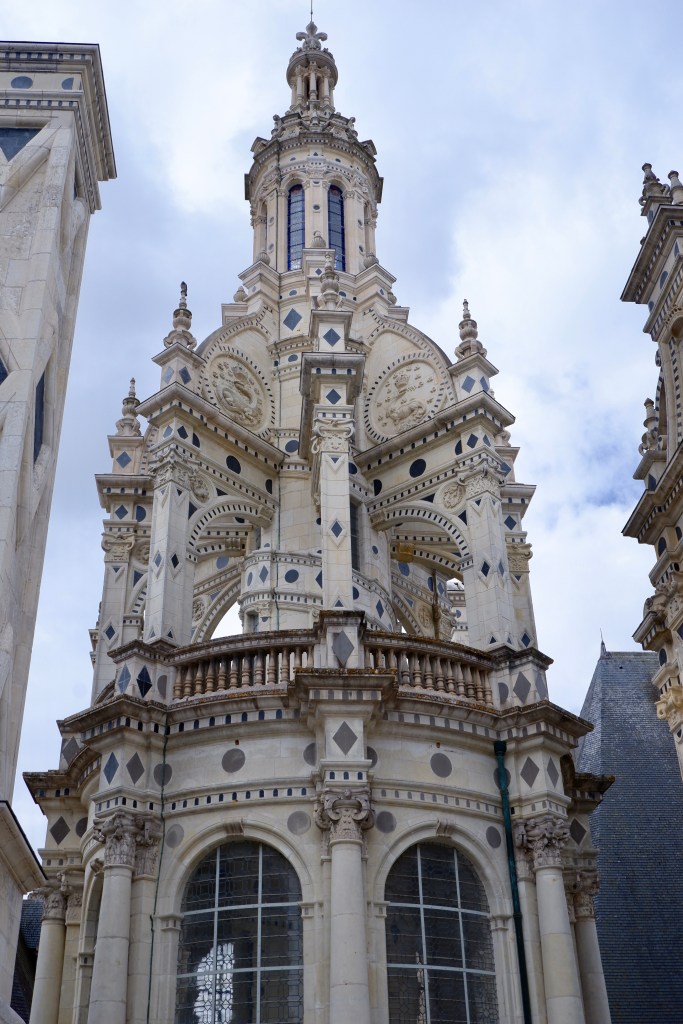
Chateau Chambord is by far the largest, grandest and most visited Chateau in the Loir Valley. The work of the stonemasons is a wonder of art and science. Begun in 1519 by Francoise 1st as a weekend hunting lodge, it quickly grew into the most ambitious and expensive architectural projects ever attempted by a French Monarch. Rising through the centre of the incredible structure, the world famous double-helix staircase, designed by Leonardo da Vinci, ascends to the great lantern tower and the rooftop. Leonardo had a fascination for the double-helix, though principally as a means of elevating water. The overall plan of the Chateau was designed on the King’s concept of chivalric principles, derived from his belief in the equality of the Knights of the Round Table. The four corner towers all had equal accommodation, including that of the king himself. Many works have been written on understanding the architecture of Chambord so any attempt of mine barely goes below the surface. One breathtaking item on display is the King’s absolutely magnificent suit of armour, manufactured in a Milan workshop in the 1500s. It’s dimensions reveal that the king must have been 6’6” tall, astounding for that time.
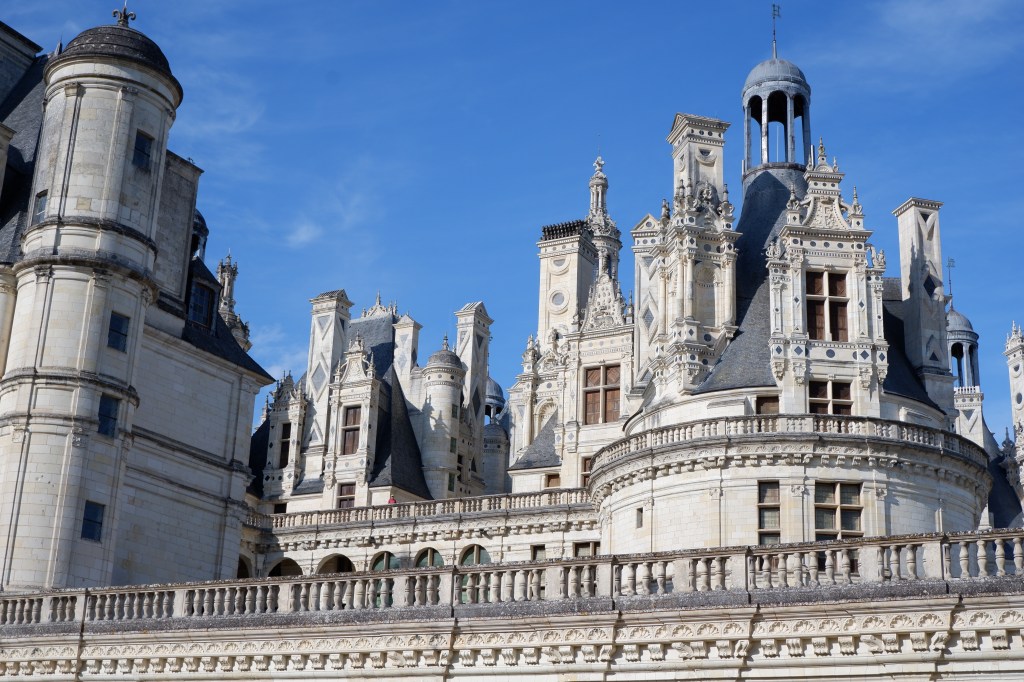
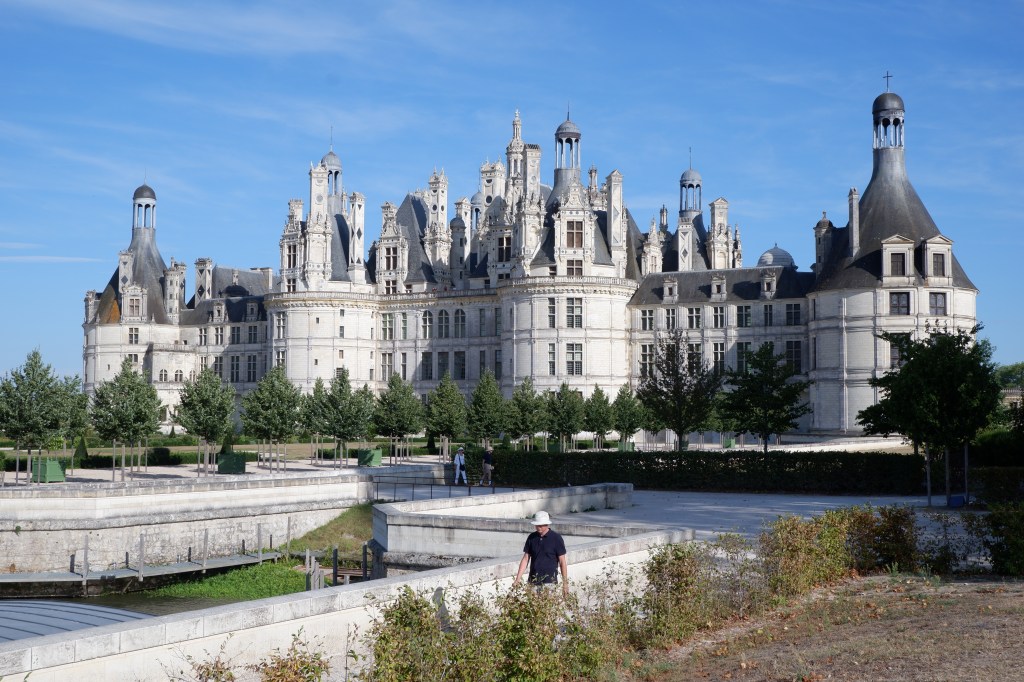
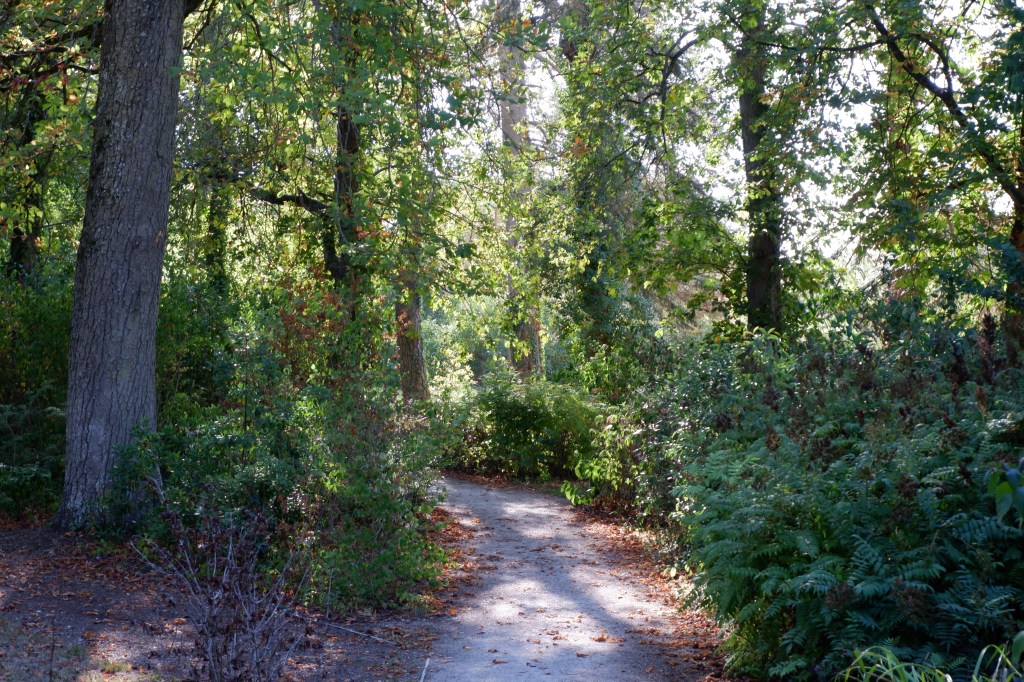
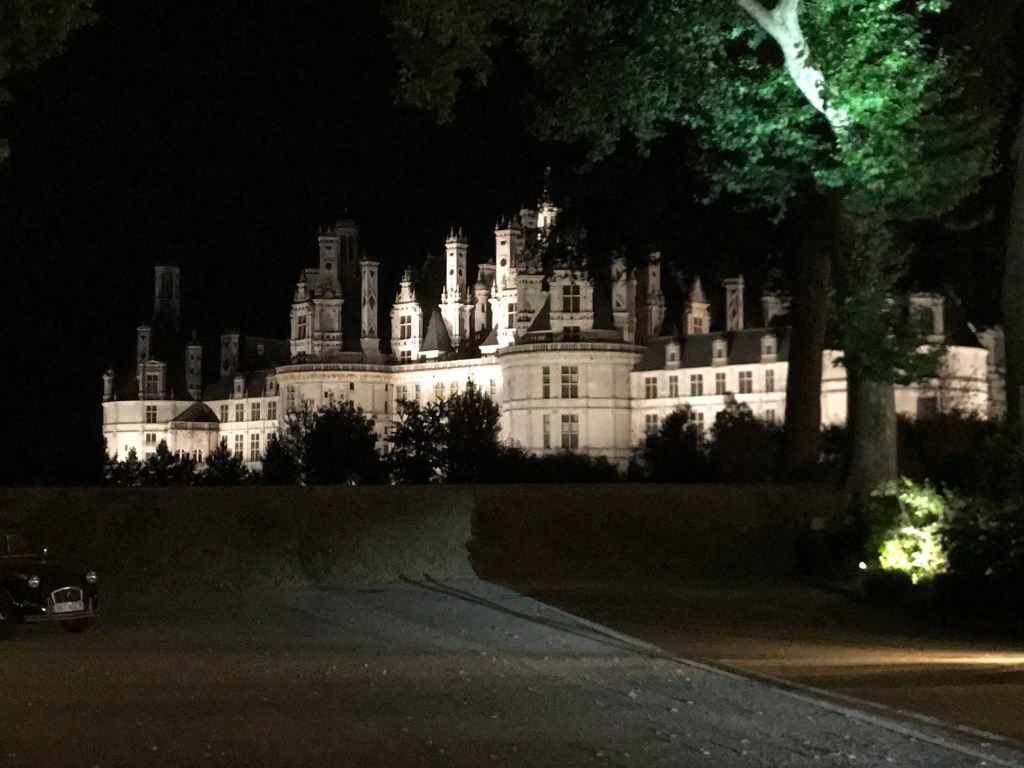
The Chateau is set in a 54 sq km hunting reserve which gives it a very special feeling. Leaving the Chateau at night we have seen deer and elk grazing. We were fortunate enough to stay in a wonderful hotel within the grounds and directly opposite the Chateau. We ate in their fantastic dining room one evening (I finally found my veal sweetbreads and they were just as delicious as I had recalled) and it was lovely to stroll out and around the Chateau while it was almost completely devoid of visitors. On other evenings we ate in nearby Blois. Our best meal there was at the fantastic ‘Les Banquettes Rouge’. I made the mistake of ordering the pate de foie gras again (mistake because of the huge portions) but my quail was absolutely delicious and I left nothing on my plate. Barry opted for prawns with beautifully seasoned quinoa followed by his favourite choice of lamb. We do plate sharings and tastings and I can attest that his meal was as delicious as mine. It is so strange that since our wine ‘education’ we are drinking white wines almost exclusively. I say ‘white’ but in comparison to the watery whites of Australia and New Zealand, these whites are straw yellow, full bodied and syrupy. Unsurprisingly, the Loire is most famous for its white wines, so why not drink what is made here? No doubt on our return to Australia we’ll go back to being Shiraz drinkers. For now, however, our favourite tipple has become Vouvray. Whether we buy a better quality one by the bottle in a shop (Under A$20 for a 2015) or order it in restaurants by the glass or half carafe in a restaurant, A$8/25, we continue to love it.
The roads to and from Chambord to Blois were extraordinarily picturesque in the French way. In other words, through quaint villages, there was often barely room for two cars to pass, and occasionally not enough room at all! But we had planned to have dinner in Blois on two of our three evenings. On the first evening, we followed the car navigation slavishly … until it instructed us to go where the local automated bollards prevented us going! The only two options ahead of us at that point were each ONE WAY but not our way! Somehow we managed to turn around and by amazing luck, found a tiny parking place on the street that we literally squeezed into. The restaurant was only a few minutes walk. As we went there, we passed the restaurant we’d booked for our second dinner, so we knew where it was.
The next day we gave ourselves a ‘lay day’ at Chambord. We slept in, ate a leisurely breakfast in the dining room at the hotel, with stunning views of the Chateau. While there were numerous bus tour groups by the late afternoon, we went before most of the crowds. By the standards of Paris attractions, the Loire Valley sites were relatively lightly attended. That made for a very enjoyable visit. The Chateau was constructed in the early 1500’s by King Francois 1st. The King had been a great patron of the arts and science and invited many Italian masters to France. The most famous of course being Leonardo Da Vinci who is said to have died there in 1519, in the arms of the King. At the moment, the region is celebrating the 500th anniversary of Leonardo’s death.
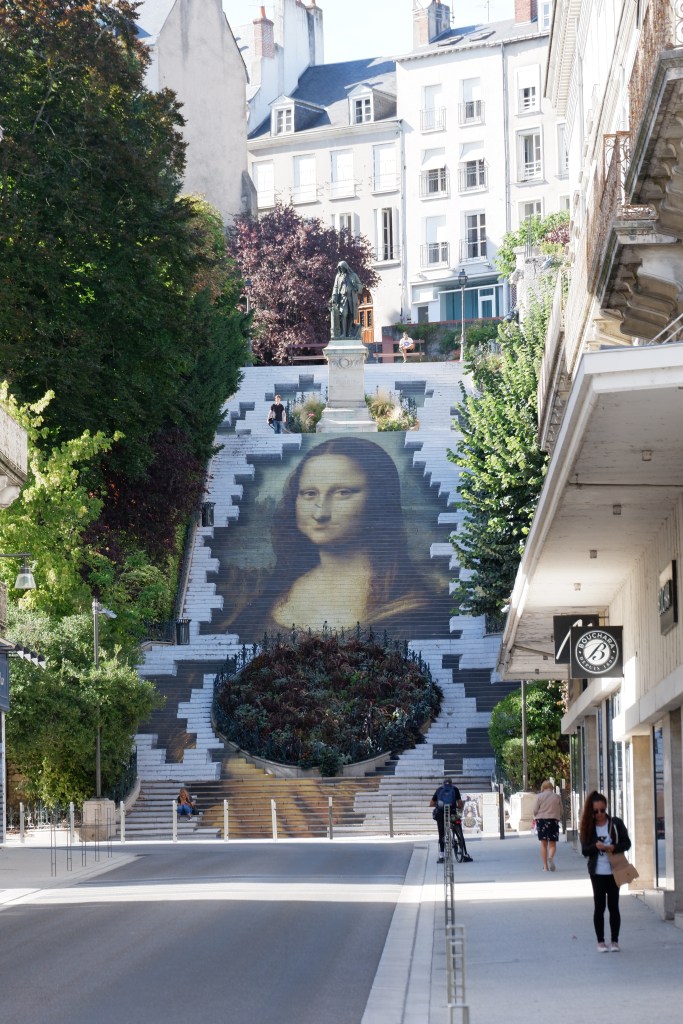
The next morning, our last full day before leaving for Orly, we decided to drive to Blois early and do our sightseeing during the afternoon, then have our dinner in the evening.
Having learned our ‘navigation’ lesson in Aix en Provence, Barry looked up a car park near the old town, close to where we wanted to be. We followed the ‘instructions’ as the maze of roads became progressively narrower, spiralling us inwards, surrounding us with one way roads on each side. Finally, in the middle of a tiny lane with cars along one side and a stone curb and wall on the other, it announced, “You have reached your destination!” Not bloody likely!! We knew the car park was supposed to be on this road Rue des Lices, but where? We trickled our way carefully between the obstacles on each side until, around a tight corner, we saw a sign to the underground park! Thank God!
The surprise was, when we came out of the car park pedestrian exit, there was the Royal Chateau of Blois right in front of us. This had been the residence of Francois 1st before Chambord was constructed. In fact, it is said that he only stayed at Chambord for not more than six months, as he found it far too draughty, and he returned to Blois. We walked up to the square in front of the Chateau. As we took in the views, we heard a strange cacophony of sounds from one end of the square. It was the famous Maison de la Magie, the home of the magician, Robert-Houdin, from whom Harry Houdini derived his stage name. The house is now a museum of magic. The windows of the house were open and, in five of them, mechanical golden dragons appeared, noisily opening their jaws widely and roaring.
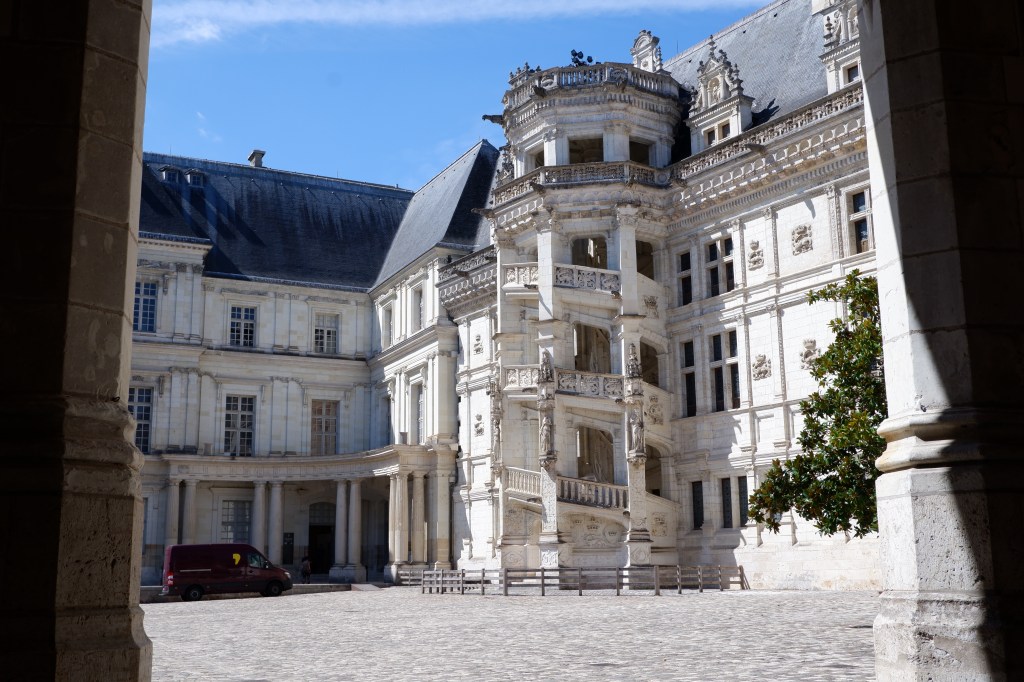
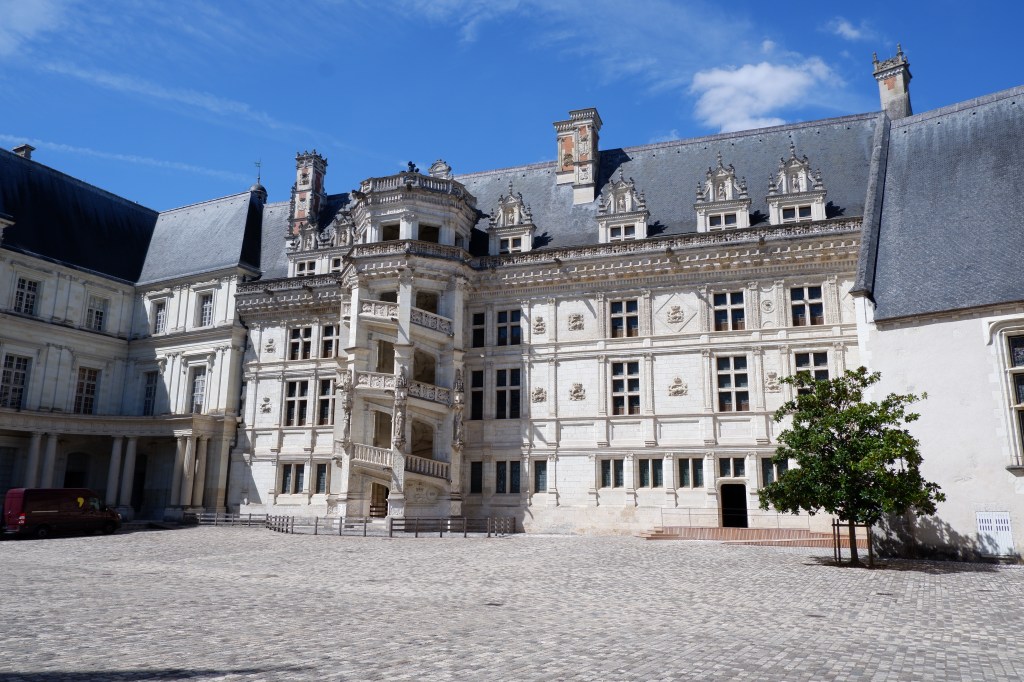
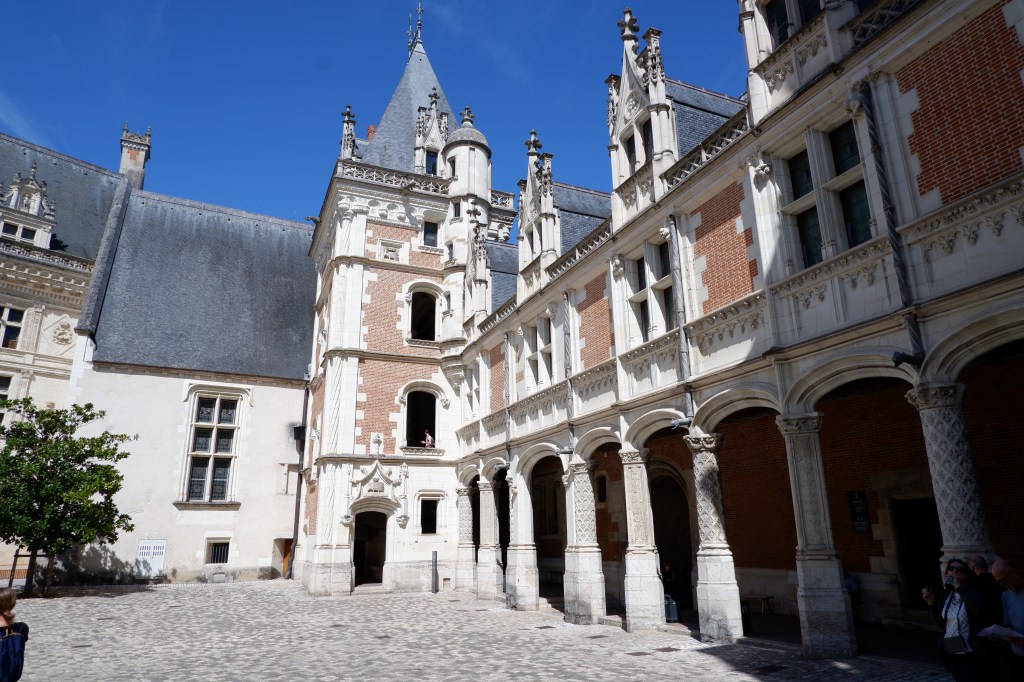
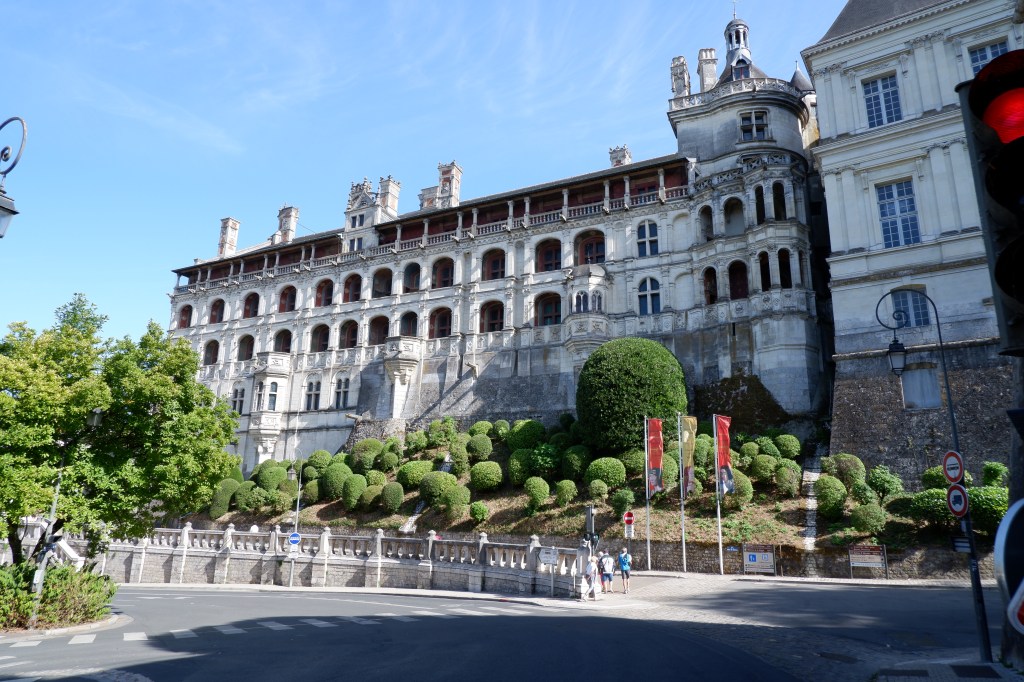

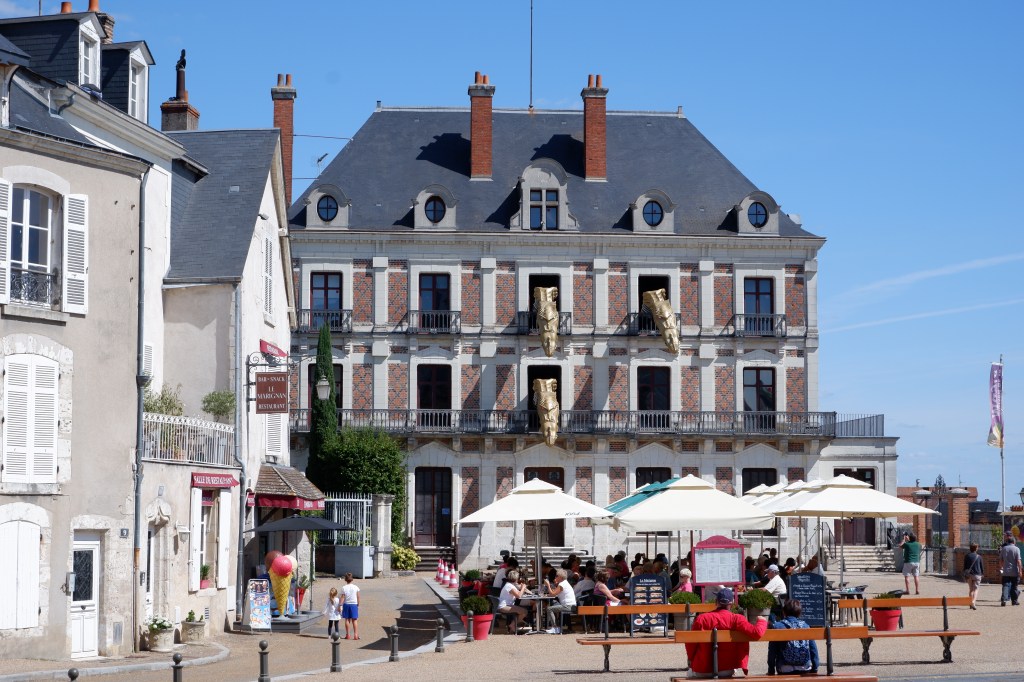
But the true wonder was inside the chateau. Having already been amazed by the sights at Chambord, we never expected to have that exceeded in Blois. France has so many magnificent historic sites. The splendour and grandeur of the attention to detail and architectural decoration in stone must be seen to be comprehended.
Seven French kings lived in Blois’ Royal Chateau, whose four grand wings were built during four distinct periods in French architecture: Gothic (13th century), Flamboyant Gothic (1498-1501), early Renaissance (1515-20) and classical (1630s). I was particularly touched by the exhibits discussing the marriage of Catherine de Medici to the then Prince Henry. At face value it would appear to have a been a love match. They were each only 14 when they married and they had ten children together, six of whom survived until adulthood and three of them became Kings with Catherine playing a large part in their reigns. Henry’s father, Francoise 1st, came to their chambers to witness the the wedding behind consummated and praise both their efforts. The Chateau still had Catherine’s ‘ceremonial bed’ with carved imaged of childbirth. There is also the chapel where she prayed every morning for his soul after he died. Yet a little research unearthed the fact that Henry took a 38 year old lover when he was only 15 and adored her for the rest of his life.
Until seeing the Blois Chateau I didn’t think that anything could surpass Chambord. Now I have to concede that just as you love all your children equally but differently, so too with the chateaux of the Loire.
Next stop Morocco!

 maryannsholidays
Again I was facinated reading about your exploits and looking at your glorious photos.
Love Jess xx
LikeLike
Hi Rod & Julie,
We’re in Marrakech, Morocco now, sweltering in the stifling heat. Inside the Medina, the Souks are rabbit warrens of commerce. Spices beyond description, leather goods, fabrics and items of every kind, tended by vendors of various Arabic ethnicities in all kinds of attire. I love to capture candid shots of people, but in the close confines of the narrow lanes in the Souk, that’s very hard to do without making it dangerously obvious!
I hope all is well with both of you. Enjoy reading the latest blog. I found driving in France, even with navigation (and sometimes because of it!) to be quite draining. But I managed to avoid a collision, although taking the wrong choice of off ramp was a frequent hazard!
Kindest Regards, Barry & Mary-Ann
Sent from my iPad
>
LikeLike